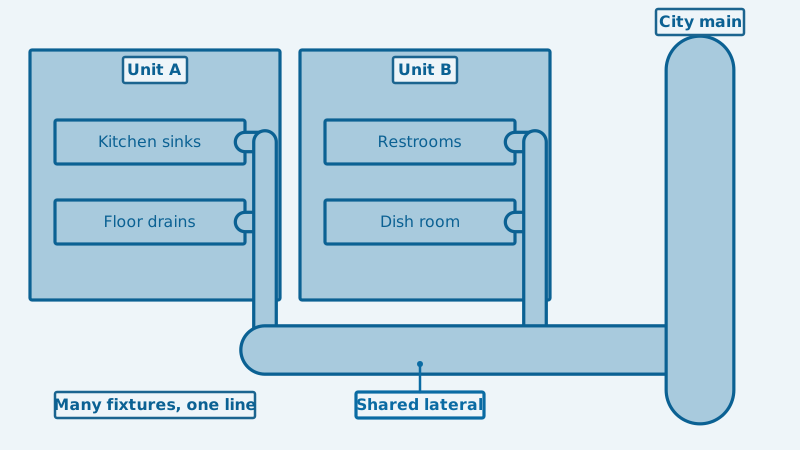
Commercial sewer cleaning clears the main line of a restaurant, shop, office or apartment building with equipment sized for larger pipe and heavier use. The lines carry more water, more grease and more paper than a home, and a clog costs a business its trading day. Our overview of sewer cleaning in Los Angeles covers the basics; the sections below are about the commercial side.
Why do commercial sewer lines clog more often than home lines?
They carry more of everything: more flushes, more kitchen waste, more paper towels and wipes, and more grease. A restaurant line takes a constant load of fats and food. An office building takes paper products from many people. An apartment building multiplies one home's habits by the number of units, and one tenant's flushed wipes can stop the building.
The most common causes of a commercial sewer line clog:
- Grease and food residue from kitchens, building up on the pipe wall.
- Paper towels and wipes in public restrooms, forming a dam.
- Roots where old clay or cast iron pipe runs under landscaping or street trees.
- Low spots and offsets in older pipe where solids settle.
- Foreign objects: mop heads, rags, construction debris.
LA Sanitation reports that over half of the backups it sees come from roots and from fats, oils and grease. In a restaurant, the second is a daily fact.
How is commercial sewer cleaning different from a home job?
The pipe is bigger, usually four inches and up, and the line is often longer and deeper. The plumber uses larger cables and high-flow jetters, and may need access through roof vents or manholes. The schedule matters too: work often happens before opening or after closing, so the business does not lose a trading day.
Differences that affect your bill:
- Equipment. Larger machines and more water volume.
- Access. Manholes, floor cleanouts and roof vents, where a house has one outdoor cleanout.
- Camera and locator. Longer runs need a camera with distance and depth readings.
- Timing. After-hours work costs more, but can save a day's sales.
- Paperwork. Landlords, property managers and insurers may want a written report with video.
For a small shop in an old building, the visit may look like a home job. For a restaurant or multi-unit building it is usually a bigger one. Our guide to commercial drain cleaning covers the branch drains inside.
What are the rules for grease in a Los Angeles restaurant?
LA Sanitation runs a Fats, Oils, and Grease (FOG) program that applies to food service businesses in the City of Los Angeles, with requirements for how grease is handled before it reaches the sewer. A grease interceptor, or trap, is often part of that. Check LA Sanitation's FOG page or ask the City what applies to your premises.
Two points that business owners confuse:
- A grease interceptor collects grease before it enters the sewer. It needs its own regular cleaning by a hauler, and a sewer cleaning visit does not replace that.
- Sewer line cleaning clears what already got through and stuck on the pipe wall. A restaurant with a neglected interceptor will see the sewer line clog again soon.
We do not set out the City's rules in detail here, because they depend on the business and on the building's plan. Ask LA Sanitation about your premises, and keep records of interceptor cleaning.
How much does commercial sewer cleaning cost in Los Angeles?
Published Los Angeles prices for a commercial building sewer line run about $800 to $2,500 or more for a cable or jet job, depending on pipe size, length, access and time of day. A grease interceptor service is a separate job, often $800 to $1,800 in published figures. A camera inspection adds $150 to $400 or more.
| Commercial job | Typical price |
|---|---|
| Building sewer line, cable or jet | $800 to $2,500 or more |
| Grease interceptor cleaning | $800 to $1,800 |
| Camera inspection of a commercial line | $150 to $400 or more |
| After-hours or emergency visit | add $50 to $300 or more |
These are guides, not quotes. A long line, roof access or a heavily rooted pipe pushes the price up. Ask for a written quote that names the equipment and the access method. Our page on hydro jetting cost shows how the jet pricing breaks down.
How often should a commercial sewer line be cleaned?
It depends on the load. Kitchens that produce grease often schedule jetting every few months. Offices and shops with a clean history may only need a camera check once a year. Let the camera and your own backup history set the interval, and avoid both neglect and cleaning for the sake of it.
A schedule that works in practice:
- Get a baseline camera inspection of the main line and keep the video.
- Clean on the interval the baseline suggests, and adjust after each visit.
- Add a root treatment if the camera shows roots.
- Keep a log of backups and cleaning dates, which also helps if you make an insurance claim.
- Brief staff on what must not go down drains: grease, wipes, paper towels.
Maintenance is cheaper than an emergency visit during service hours, where sewage backing into a dining room or restroom closes the business. Our page on emergency sewer backup lists the first steps if it happens.
Who is responsible for the sewer line at a commercial property?
Typically the property owner is responsible for the private lateral, and a lease decides how a tenant shares the cost. In the City of Los Angeles, LA Sanitation says the owner maintains the whole private sewer lateral, including the part under the street. Check your lease, and tell the landlord of a backup quickly.
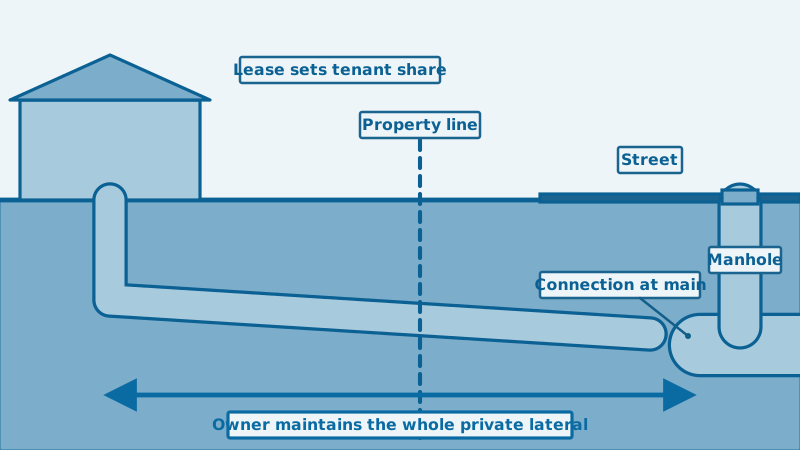
If the cause is a city main, LA Sanitation runs a 24-hour Customer Care Center at 1-800-773-2489. If it is in your lateral, the owner arranges and pays unless the lease says otherwise. Repair work must be done by a contractor with the right CSLB classification when the job is $1,000 or more in labor and materials, and city permits apply for lateral repairs.
To price a commercial line, request a written price and tell us the type of business, the symptom and the building age. Our home page lists the rest of what we arrange.
Questions people ask
Can commercial sewer cleaning be done after hours?
Often yes. Many contractors offer early morning, evening or weekend visits so the business can keep trading. After-hours work usually costs more, and some access, such as roof vents, may be limited at night. Ask the price difference when you book.
Does commercial sewer cleaning include a camera inspection?
Sometimes. Many contractors include a camera pass or discount it with cleaning, and others charge separately. A camera shows the cause of the clog, which matters most on a commercial line. Ask whether the video is included and in what format.
How long does commercial sewer cleaning take?
A simple clog in an accessible building line can take one to two hours. A long, root-filled or multi-unit line can take half a day or more, with a camera pass after. Ask for a window, and plan when staff and tenants can be without water use.
What should I ask before I hire a company for commercial sewer cleaning?
Ask for a written price, the equipment they will use, how they will reach the line, whether the price covers after-hours work and camera, which CSLB classification they hold, and whether they provide a report with video. Ask if they will clear a grease interceptor separately.
Sources used
- LA Sanitation, Fats, Oils, and Grease (FOG) program
- LA Sanitation, Managing and Protecting LA's Underground Sewer System
- CSLB, Industry Bulletin 24-07, AB 2622: license requirement for minor work rises to $1,000
- Published prices of Los Angeles commercial drain and sewer cleaning businesses, checked November 2026
Page updated