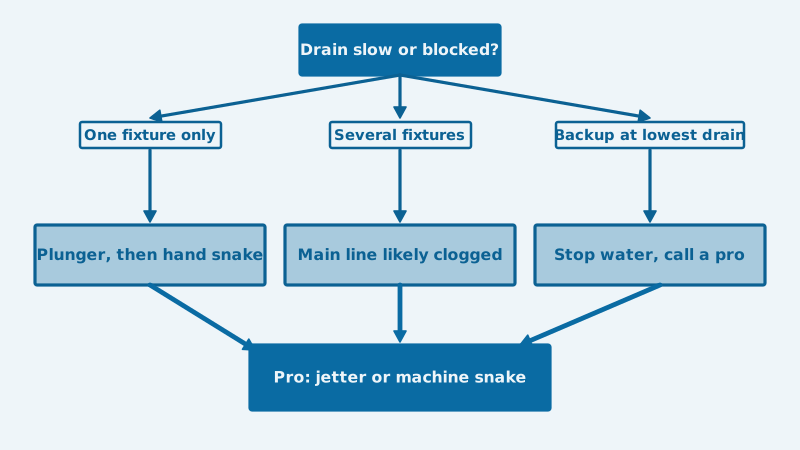
If one of your fixtures drains slowly, you can often fix it yourself. If several drains slow down together, a toilet gurgles when the shower runs, or water comes up where it shouldn't, the blockage is in a shared line and a drain cleaning company is the right call. In Los Angeles most jobs cost roughly $150 to $900, and the price depends on where the clog sits.
This page explains how to tell which case you have, what a visit involves, and where sewer repair starts. For the machine most jobs use, see drain snaking. For stubborn buildup, see hydro jetting. Back to the LA Drain Works home page any time.
Is professional drain cleaning worth it?
Yes, once a blockage is more than one fixture deep. A plunger and a hand tool reach a few feet. A plumber's cable machine reaches 50 to 100 feet or more, and a camera shows what is actually in the pipe. You pay for reach and for knowing the cause, so the clog does not come back in two weeks.
The calculation is simple. Good drainage is cheap to keep and expensive to lose. A one-off visit for a single blocked line costs far less than water damage from a backup. Waiting also costs more when the cause is roots or a collapsed section: those get worse every month, and a camera finds them early.
Professional cleaning is not worth it for a bathroom sink with a hair clog you can see. Pull the stopper, clear it, and move on. See cleaning a basin drain for that job.
What are the warning signs of a clogged drain line?
Slow draining in more than one fixture, gurgling from a toilet or tub, a sewer smell indoors, and water backing up in the lowest drain in the house are the main warning signs. One slow sink is usually local. Several symptoms together point to the main line or the lateral to the street.
Signs worth acting on the same week:
- A toilet bubbles when you run the washing machine or a shower.
- A floor drain, shower or tub in the lowest part of the house fills with grey water.
- Drains were slow before and a chemical cleaner only helped for a few days.
- A wet patch or unusually green strip of lawn over the sewer line.
A backup is not a warning sign any more, it is the emergency. If that is where you are, read emergency drain cleaning.
Can I unblock a drain myself?
You can clear a single fixture yourself: a cup plunger, a hand-cranked hair tool or a cleaned P-trap handles most sink, tub and shower clogs. Stop when the water backs up elsewhere, when a hand tool meets a hard stop, or when you have used a chemical cleaner and nothing moved.
Be careful with chemical cleaners. Lye-based products can burn skin and eyes, and mixing products can release toxic gas. If a cleaner is already sitting in the pipe, tell the plumber before the visit, because caustic liquid can splash back when a cable turns. A plunger or a hand snake is the safer first try.
For fixture-by-fixture help, the guides on shower drains and kitchen and bathroom sinks go step by step.
What does a drain cleaning visit involve?
A local plumber comes to your property, finds the nearest access point (a cleanout, a trap or a fixture), runs a cable or a jet hose through the line, and confirms the water flows freely before leaving. If the cause is unclear, a camera goes in. You get a written quote before any work starts.
The usual sequence:
- The plumber asks which drains are affected and since when. That narrows the blockage to a branch line or the main.
- They find access. Outdoors, that is often a capped cleanout pipe in the yard or beside the house. Indoors it can be a tub trap or a roof vent.
- They clear the blockage with the right tool for the cause: a cable for soft clogs and roots, a jet for grease and scale.
- They run water to test flow, and a camera if the problem looks structural.
Outdoor drain and cleanout work is part of the same service. If you are searching for outdoor drain cleaning near you, the visit is the same, just from the cleanout rather than a fixture.
How much does drain cleaning cost in Los Angeles?
Most single-line jobs run about $150 to $350. A main sewer line clean-out typically falls between $250 and $600, with jetting adding to that, and heavy roots or an after-hours call pushing totals toward $900 or more. These are published local ranges as a guide, and a written quote after a visit sets your real price.
What moves the number:
| Factor | Effect on price |
|---|---|
| Single fixture vs main line | Main line costs more |
| Access (a cleanout vs pulling a toilet) | No cleanout means more labor |
| Cause (hair, grease, roots) | Roots and scale need heavier tools |
| Camera inspection | Often adds about $150 to $350 if separate |
| Evening, weekend or holiday | Often adds a call-out premium |
Ask whether a camera look is included. It is the cheapest way to avoid paying twice for the same clog.
Do I need a permit to fix my sewer line?
Clearing a clog needs no permit. Repairing or replacing sewer pipe in the City of Los Angeles does. Work on private property goes through the Department of Building and Safety, and work in the street or sidewalk area is handled separately by the city. Your plumber normally pulls the permit, so confirm that it is included in your quote.
In California, a contractor must hold a license from the Contractors State License Board for plumbing work that needs a permit or reaches a set dollar value, so check the number the CSLB currently uses. You can look up any contractor by license number on the CSLB site before you agree to a quote.
Unpermitted sewer work can cause problems when you sell the home or make an insurance claim, so do not agree to cash work with no paperwork.
Who owns the pipe, you or the city?
In the City of Los Angeles you own the private sewer lateral all the way from the building to the connection at the street main, including the part under the public street. The city owns the main itself. LA Sanitation says tree roots and poured fats, oils and grease cause more than half of sewer backups.
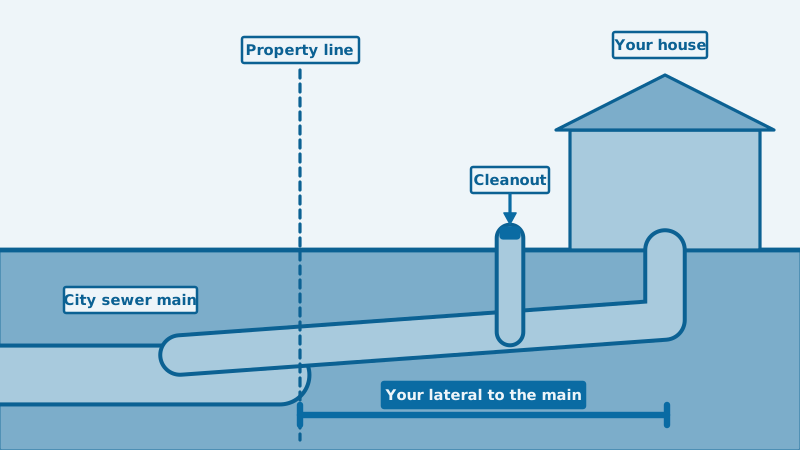
That matters when you decide who to call. If only your home is backing up, the blockage is almost always in your lateral. If several neighbors have the same problem, or sewage comes up from a manhole in the street, the main is the likelier cause and you should report it to the city or to LA County Public Works if you live in an unincorporated area.
Can a sewer line be repaired, and can it be done without digging?
Yes to both, in many cases. A cracked or root-invaded section can often be lined from inside the pipe, or replaced by pulling new pipe through the old, without trenching the yard. Collapsed pipe, Orangeburg fiber pipe and some badly offset joints usually need excavation.
Older Los Angeles homes often have clay, cast iron or Orangeburg laterals, and each fails differently. A camera inspection decides which repair fits. The pages on no dig sewer line repair and sewer line repair cover methods, prices and trade-offs. Insurance rarely pays for the pipe itself, and standard homeowners policies typically exclude sewer backup unless you added an endorsement, so check your policy before you assume.
Ready for a visit at your place? Tell us what is slow or backing up on the price request page, and the written quote follows the visit.
Questions people ask
What is the strongest drain cleaner?
Mechanical clearing beats any bottle. A cable machine or a hydro jet physically removes the blockage, while chemical cleaners such as lye-based gels only dissolve some organic material and can damage old pipe or injure you. If a product fails once, do not stack a second one on top. Call a plumber instead.
How deep should sewer lines be buried?
It depends on the lot, the slope and the age of the house. It varies widely, and it is deeper where the street main is deep. Your plumber can locate and measure yours with a camera and locator before quoting any dig.
Does insurance cover sewer line repairs?
Standard homeowners policies typically cover sudden damage inside the home but exclude sewer or drain backup unless you bought a water backup endorsement. The pipe itself, from wear or roots, is generally your responsibility. Read your policy or ask your insurer which wording applies to you.
Does replacing a sewer line increase home value?
It protects value more than it adds it. A buyer's inspection often includes a sewer camera in older Los Angeles neighborhoods, and a failing lateral can hold up a sale or lower the offer. A documented, permitted replacement removes that risk. It rarely adds more than it costs.
Do you offer emergency drain cleaning service?
Yes, we arrange emergency visits for backups and overflowing drains. Availability and any after-hours charge are confirmed when we arrange your visit, and your plumber states the price in writing before starting. Details are on the emergency drain cleaning page.
Sources used
- How LA Sanitation describes private sewer laterals
- LA County Public Works, sewer maintenance
- California Contractors State License Board, hiring a contractor
- Drain cleaner, safety and chemistry
- Published prices of several Los Angeles plumbing businesses, checked November 2026
- Los Angeles Department of Building and Safety permit rules for plumbing work
Page updated