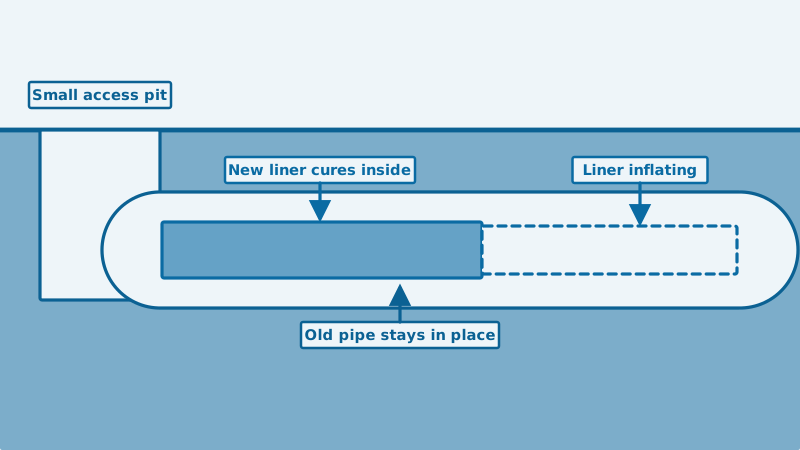
No dig sewer line repair means fixing a damaged sewer lateral without opening a trench along its whole length. A crew either lines the old pipe with a resin sleeve, or pulls new pipe through the old one and breaks it apart as it goes. It suits cracked, root-invaded and leaking clay or cast iron pipe, and it does not suit pipe that has collapsed.
If you are choosing between methods, pipe lining vs replacement compares them side by side. Return to LA Drain Works for the full list of services.
How does no dig sewer repair actually work?
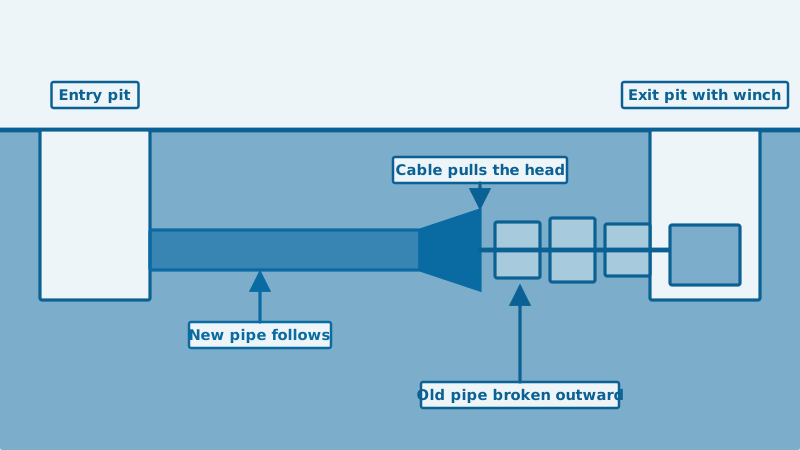
Two methods cover most jobs. In lining, a felt tube soaked in resin is pulled or inverted into the pipe, inflated and cured hot, leaving a new pipe inside the old one. In pipe bursting, a cone pulls new plastic pipe through the old line, cracking the old pipe outward into the soil.
Every job starts with a camera. It shows the pipe's material, where it is cracked, offset or invaded by roots, and how far to the street. Before lining, the pipe is cleaned out, often with a hydro jet, because the liner must bond to a clean wall.
The two methods side by side:
| Lining | Pipe bursting | |
|---|---|---|
| What you get | Pipe inside the old pipe | Brand new pipe replaces old |
| Pipe size | Slightly smaller bore | Same or larger bore possible |
| Needs | Pipe still round, no big gaps | Space at both ends for pits |
| Poor fit | Collapsed or flattened pipe | Pipe running close to other utilities |
What are the disadvantages of trenchless pipe lining?
The main limits are that the pipe must still be round and mostly connected, the bore shrinks slightly, and it cannot fix a pipe with a sag or belly that holds water. Lining also won't work on Orangeburg fiber pipe, which deforms and does not give a stable surface for the liner to bond to.
Other points to weigh:
- Side connections and cleanouts are cut open afterward with a robotic cutter, so a bad cut can leave a lip.
- A belly (a low spot) stays a low spot. The liner follows the old shape.
- Each liner needs enough cure time, and the line is out of service while it cures.
- Poor installation shows up as wrinkles or an incomplete bond, so ask who does the work and what they photograph.
What are the disadvantages of trenchless pipe replacement?
Pipe bursting needs an entry pit and an exit pit, so some digging remains. It can disturb nearby utilities if the old pipe sits close to a gas or water line, and it does not work well where the old pipe has been repaired with concrete collars or has shifted badly. It also costs more than lining a short run.
In older Los Angeles neighborhoods, lots are often narrow and utilities are packed close together, so a locate and a careful plan come before any bursting. Hillside properties can add steep pits and access limits that raise the price.
Is trenchless sewer repair worth it?
Often yes, when the pipe runs under a driveway, patio, mature tree or finished landscaping. Digging up and rebuilding those surfaces can cost as much as the pipe work, so a higher per-foot trenchless price often finishes at a similar or lower total. On open, shallow lawn, a trench can win.
Ask for both prices on the same line, written out. Include the cost of restoring the surface in the trench option. Many homeowners compare only the pipe work and then get surprised by concrete and landscaping.
A trenchless sewer line repair is not worth it if the pipe is crushed, if there is a large missing section, or if the line has several belly sections. Then replacement is the honest answer and the camera footage will show it.
What is the cheapest way to replace a sewer line?
The cheapest sewer line replacement method is the one that fits the pipe and the site. On open ground with shallow pipe, an open trench usually costs the least. Under a driveway or finished landscaping, lining or bursting is often cheaper overall. A spot repair of one broken section is cheaper than either when the rest of the pipe is sound.
Published California prices vary widely. As a guide, lining is often quoted at about $80 to $250 per foot, pipe bursting at about $60 to $250, and open trench at about $50 to $250 before surface restoration. A whole lateral replacement is commonly $5,000 to $25,000 or more. Your written quote after a camera visit sets the real figure.
What are four signs that your sewer line is broken?
Four signs are repeated backups in the lowest drain, gurgling toilets or tubs, a sewer smell in the house or yard, and wet or unusually green spots over the line. A camera confirms the cause. Slow drains alone are usually local, so look for the pattern across fixtures.
Other clues include foundation settling near the lateral, cracks in a driveway above the line, and rodents. Tree roots are a common cause in Los Angeles, where mature trees often stand close to old clay laterals, and LA Sanitation lists roots and grease as the cause of more than half of sewer backups.
Do I need a permit, and does insurance pay for it?
Sewer repair or replacement in the City of Los Angeles needs a permit. Work on private property goes through the Department of Building and Safety, and work in the public street area is handled separately. The plumber normally pulls it. Standard homeowners policies typically exclude sewer lines and sewer backup, so assume you pay unless your policy says otherwise.
This is the answer to "who pays for sewer line repair" and "does my insurer cover it". You own the lateral up to the street connection, so the cost falls on you. A policy with a service line or water backup endorsement may pay part. That includes insurers such as USAA, so read your own policy rather than assume. Ask the insurer in writing before work starts, and keep the camera footage.
California requires a contractor license for plumbing work that needs a permit or reaches the state's dollar threshold. Verify the license number on the CSLB website before you sign.
To see what your own line needs, describe it on the price request page. A camera visit comes first, then the written quote.
Questions people ask
Can you repair a sewer line without digging it up?
Often, yes. Cracks, root intrusion and failed joints in clay or cast iron can usually be lined from inside, or the whole run can be replaced by bursting. Collapsed pipe, severe bellies and Orangeburg fiber pipe usually need some excavation. A camera inspection tells you which applies before you commit.
What is the average cost to repair a sewer line?
Spot repairs are commonly quoted at roughly $1,500 to $5,000. Full lateral replacement is commonly $5,000 to $25,000 or more, depending on length, depth and what sits above the pipe. Treat those as published guides. A written quote after a camera visit gives your actual number.
Can I replace a main sewer line myself?
Not legally in most cases. Replacing a sewer line in Los Angeles needs a permit and an inspection, and California requires a contractor license for plumbing work that needs a permit. It also involves deep excavation and locating buried utilities. You can help by clearing the area and checking the cleanout.
How do I unblock my main sewer line?
Start with a cable or jet from the cleanout, which clears most root and grease clogs. If the clog returns within weeks, the pipe has a defect and clearing alone will not hold. See main line drain cleaning for the steps and the signs to look for.
Can I do hydro jetting myself?
Rented jetters exist, but pressure and nozzle choice matter. Too much pressure on weak clay or cast iron can crack it, and a jetter can injure you. A plumber usually runs a camera first to check the pipe can take the pressure, and chooses a lower setting for older pipe. Read hydro jetting before deciding.
Guides in this section
- Insurance and sewer replacement
Sewer line replacement is rarely covered by a standard homeowners policy.
- How does trenchless sewer repair work
How trenchless sewer repair works in Los Angeles: pipe lining and pipe bursting step by step, what it costs per foot, permits, and when…
- Pipe lining vs replacement
Pipe lining vs replacement for a Los Angeles sewer lateral: a decision guide by pipe material and damage, with cost ranges for lining,…
- Sewer line replacement contractors
How to pick a sewer line replacement contractor in Los Angeles: the license classes, permits, quote checks, deposit limits and red flags,…
- What sewer line replacement costs
What sewer line replacement costs in Los Angeles by method, per foot and per job, what pushes the bill up, and what insurance and permits…
- Sewer pipe lining cost
Sewer pipe lining costs roughly $80 to $250 per foot, or $5,000 to $12,000 for a typical lateral.
- Sewer pipe lining
Sewer pipe lining seals a cracked or root-filled lateral from inside, with little digging.
- Trenchless pipe replacement
Trenchless pipe replacement swaps a failed sewer line without a full trench.
- Why replacement costs so much
Sewer line replacement costs thousands because of depth, length, permits and restoration, not just pipe.
Sources used
- How LA Sanitation describes private sewer laterals
- Cured-in-place pipe, overview of the lining method
- Pipe bursting, overview of the method
- Orangeburg pipe, history and failure
- California Contractors State License Board, hiring a contractor
- Published trenchless and open-trench prices from several California plumbing businesses, checked November 2026
- Los Angeles Department of Building and Safety permit rules for sewer work
Page updated