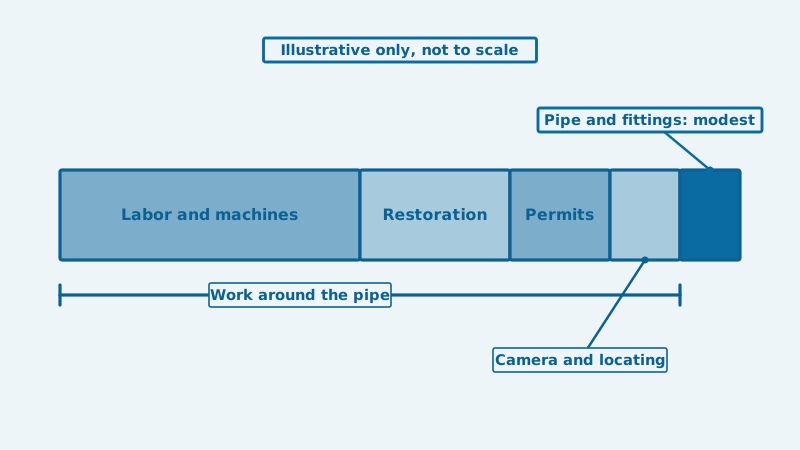
Sewer line replacement looks like a simple swap of one pipe for another, so the price surprises people. The pipe itself is a small share. Most of the cost is the work around it: finding the line, digging a deep trench, shoring it, getting permits and inspections, and putting the landscaping or concrete back. Published guides from California plumbing businesses put full replacements somewhere in the range of about $5,000 to $25,000 or more, with spot repairs lower, but your own line decides where you land. For ways to avoid digging, start with no-dig sewer line repair.
What are you actually paying for?
The price is made of labor, equipment, pipe, a camera inspection, permits and inspections, and restoration of whatever was dug up. Labor and machines make up most of it. A crew has to locate the pipe, excavate, lay new pipe at the right slope, connect it at both ends, test it and refill.
A rough breakdown of the pieces:
- Camera survey to find the length, depth and defects, before any quote can be firm.
- Locating and marking the pipe and calling for underground utility marking before digging.
- Excavation or access pits, depending on the method.
- Pipe and fittings, which are modest compared with labor.
- Permits and inspection, covered below.
- Restoration: soil, sod, concrete, pavers, fencing.
Treat any number you read online as a guide. We do not publish a fixed price here because depth and access change it so much, and the quote after a camera visit is the real figure.
Why does the length and depth of the pipe matter so much?
Because every extra foot has to be dug, supported and restored, and deeper trenches cost more per foot. Longer runs mean more labor and more surface to repair. Depth adds shoring, bigger machines and slower work, so a lateral that is deep at the street can cost far more than a shallow one.
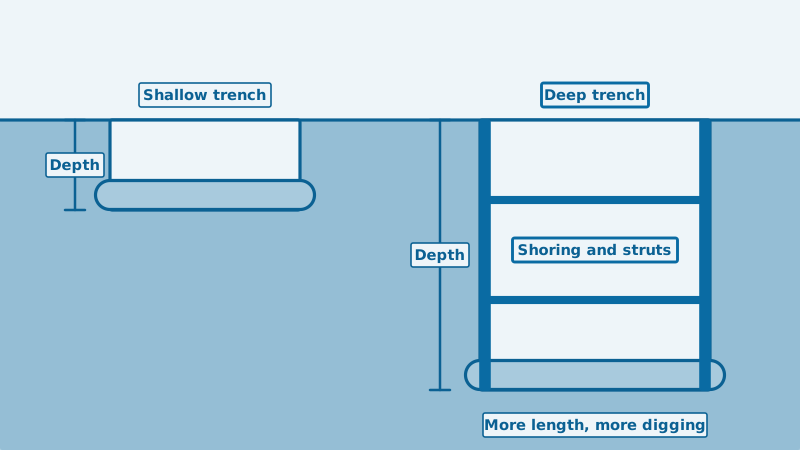
Published calculators suggest depth beyond about six feet adds a noticeable percentage per foot for shoring and spoil, and over ten feet adds more again. Those are contractor estimates, not official figures, but the direction is the same everywhere. A long lateral on a sloped or hillside lot, where the pipe at the street is deeper than at the house, is a common reason a quote lands high.
How do permits and the street drive up the cost?
In Los Angeles, sewer work needs permits, and the part under the sidewalk or street needs a separate one. Repairs on your own property typically go through the Department of Building and Safety. Work in the public right of way needs a Bureau of Engineering S-Permit and a bonded sewer contractor, which adds fees and time.
You also own the whole lateral. In the City, the owner is responsible for the private lateral all the way to the public main, including the part under the street, and LA County Public Works says the same in unincorporated areas. So a break near the street is still your bill, and street work means traffic control, trench plates and pavement repair to city standards.
Permit fees and timelines differ by job. Some online sources quote specific figures for Los Angeles, but they come from contractors, so check the current fee schedule or ask the plumber to list what is included in the quote.
Why can restoration cost more than the plumbing?
Digging up a yard means putting it back. Lawn is cheap to restore, but concrete driveways, patios, stamped walkways, mature plants and fences are not. Trade guides note that restoration can equal or exceed the plumbing bill when a trench cuts through hardscape, which is common in Southern California.
Ask whether the quote includes restoration and to what standard. "Backfill only" means you pay a second contractor for concrete and landscaping. A clear quote lists what is replaced and what is left for you.
How does trenchless sewer repair change the price?
Trenchless sewer repair replaces or lines the pipe from two small access pits instead of a long trench. Pipe bursting pulls new pipe through the old one, breaking it outward. Cured-in-place lining forms a new pipe inside the old. These methods cost more per foot in some cases but often save on restoration.
Sources disagree about whether trenchless is cheaper overall. It tends to win when the line runs under a driveway, patio or mature trees, and when the existing pipe holds its shape well enough to line. Open trenching tends to win for a shallow line under plain lawn, for a badly collapsed pipe, or when the grade needs to be corrected. A trenchless sewer line also finishes faster, often in a day or two of work, though that depends on the job.
Our pages on trenchless pipe replacement and pipe lining versus replacement compare the methods in more detail.
Does an emergency make it cost more?
Yes. A line that has collapsed and is backing up into the house forces fast decisions, after-hours work and little time to compare quotes. The cost of the sewer line replacement itself may be the same, but you lose the chance to plan and to choose the cheaper method.
That is the real argument for a camera inspection while the line still works. If you know the pipe is clay, cast iron or Orangeburg near the end of its life, you can schedule the work, apply for permits and compare options, rather than paying for an emergency job. See sewer line repair cost for how the options compare.
Can you lower the cost?
Often, yes. Get a camera inspection first so the quote is based on facts, ask for the footage, compare at least two written quotes that spell out what is included, ask whether spot repair or lining could fit instead of a full replacement, and check whether your insurance has any sewer coverage.
Be careful with the cheapest quote. If it leaves out permits, inspection, cleanout installation or restoration, it will cost more by the end. Sewer replacement must also pass inspection where a permit applies, so a contractor who suggests skipping the permit is a risk to you when you sell the house or file a claim.
Also check whether home insurance covers sewer line replacement, since most standard policies treat wear, age and roots as exclusions.
For a written, itemized quote on your own line, request a price and we'll arrange a camera visit. You can also go back to the LA Drain Works home page.
Questions people ask
How long does sewer line replacement take?
An open-trench job usually takes several days plus restoration. Trenchless replacement or lining is often finished in a day or two of work. Permits and inspections add waiting time that has nothing to do with the crew, so ask for a schedule that counts them.
What should I ask before I hire someone for sewer line replacement?
Ask whether the quote includes the camera survey, permits, inspection, a cleanout and restoration. Ask which method they recommend, why, what happens if they find something unexpected, and how payment is staged. Get all of it in writing before work starts.
Do I need to be home during the work?
Not for every hour, but someone should be there at the start and at inspection. Water use will be limited during the work, and the crew needs access to the yard and the cleanout. Plan around no toilet use for part of a day.
Is it cheaper to repair than to replace?
A spot repair costs less when the rest of the pipe is sound, but several spot repairs on a failing pipe can cost more than one replacement. The camera footage should show whether the damage is in one place or along the whole run.
Will my neighbors' trees or the city tree cause this?
Roots from neighboring trees can enter your pipe, and you are still responsible for the lateral. If the roots come from a street tree, the City requires a permit before any street tree is trimmed or root pruned, so call before cutting anything.
Sources used
- City of Los Angeles Bureau of Engineering, S-Permit manual
- LA County Public Works, sewer lateral customer information
- LA Sanitation, managing and protecting LA's underground sewer system
- Published cost guides from California and Los Angeles plumbing businesses, checked November 2026
Page updated