Trenchless sewer repair works by reaching the old pipe from one or two small holes, then either lining it from the inside or pulling a new pipe through it, so the yard and driveway stay mostly intact. A trenchless sewer line job, in other words, trades the long trench for pits. The two common methods are cured-in-place lining and pipe bursting. Our overview of no-dig sewer line repair covers the choice at a higher level. This page covers how each method actually runs on site.
How does the trenchless pipe lining method work?
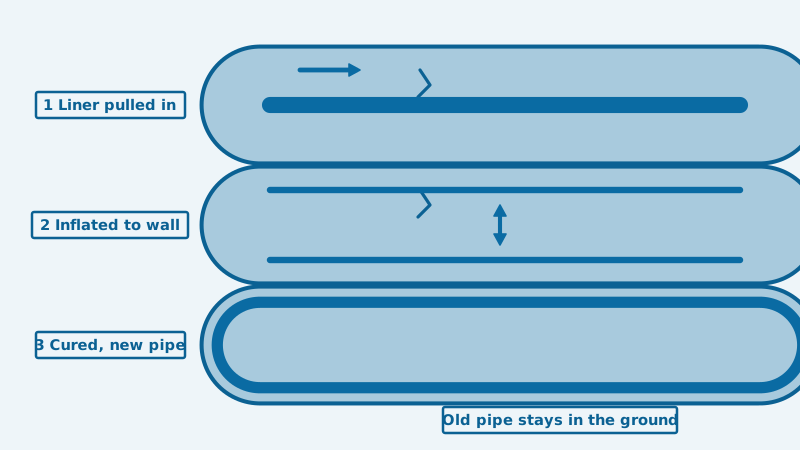
Pipe lining, called cured-in-place pipe, or CIPP, pushes a resin-soaked felt tube into the old pipe and hardens it into a new, seamless pipe inside the old one. The line is cleaned and inspected first. Then the tube is inflated, cured with hot water, steam or light, and the service connections are reopened.
The sequence on a typical house line:
- Clean and scope. The pipe is jetted, and a camera records its condition. Roots and debris must be gone, or the liner will wrinkle around them.
- Prepare the liner. A felt tube is soaked in resin, usually cut to length for your line.
- Pull or invert it in. It goes in through a cleanout or a small access pit and is pushed against the pipe wall with water or air.
- Cure. Hot water, steam or UV light hardens the resin. Curing can take anywhere from one hour to many hours.
- Reopen and check. Any side connections are cut open from inside, then a second camera pass confirms the result.
A liner can fix cracks, open joints and root entry points in a pipe that still holds its shape. It does not fix a collapsed pipe or a deep sag where water sits. It also reduces the pipe's inside diameter slightly, and a lined pipe cannot be cleared with a cutting cable afterward, so later cleaning is done by water jetting.
How does pipe bursting work?
Pipe bursting replaces the old pipe by pulling an expander head through it. The head cracks the old pipe outward into the soil, and a new pipe, usually plastic, is pulled in behind it. It needs an entry pit and an exit pit, but no trench the length of the line.
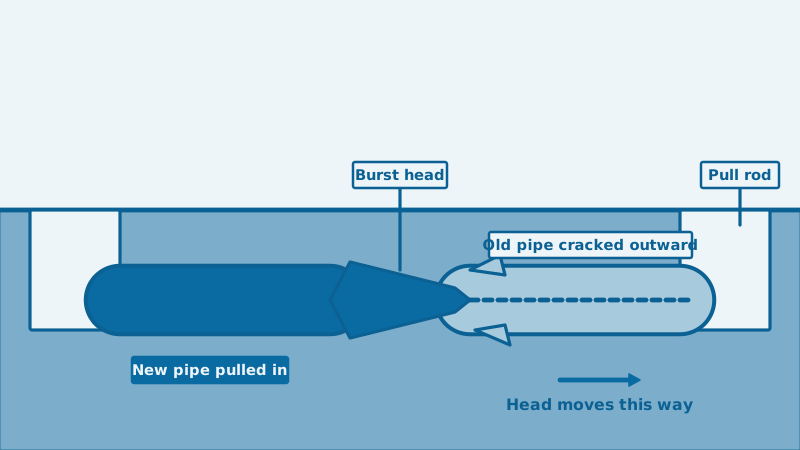
The crew digs a launching pit at one end of the run and a receiving pit at the other, often at the house cleanout and near the street connection. A cable or rod is threaded through the old pipe, attached to the bursting head and the new pipe, and a hydraulic machine pulls the assembly through. The old pipe fragments stay in the ground.
Pipe bursting suits pipes that are cracked, collapsed, offset or sagging, because the new pipe follows a fresh path along the old one. It is a true sewer line replacement, not a repair of the old pipe's walls. That matters in Los Angeles, where older homes can have clay, cast iron or Orangeburg laterals. Orangeburg, a bonded fiber pipe used mainly from the 1860s to the 1970s, is brittle and often fails early, so it is a common candidate for replacement. Pipe bursting still needs a quick look at what is around the line, such as other utilities, large trees and tight neighbors' fences.
Is trenchless sewer repair effective, and when is digging still needed?
Trenchless repair is effective on pipes that are straight and structurally intact, and it can replace pipes that are failing. Digging is still needed when the pipe has collapsed in a way a machine cannot pass, when the grade is wrong and water sits in a belly, or when a fitting needs to be changed.
Trenchless is not automatically better. Think of three questions:
- What is the pipe's condition? The camera answer is the one that matters. Lining needs a pipe that is still round enough. Bursting handles worse pipe.
- Where does it fail? A single broken joint or short section may be a spot repair with a small dig, not a full line job.
- What is the slope? Both methods follow the line that is already there. A pipe with a belly stays a pipe with a belly.
A short dig for a pit is still much less than a full trench. Landscaping, concrete and fences along the line are mostly left alone. For a side-by-side look, see pipe lining versus replacement and trenchless pipe lining.
Is trenchless sewer repair cheaper than digging?
Not always. Published California prices for trenchless work are often quoted from about $80 to $250 per foot, with Southern California toward the upper part. Trenching has its own price and adds restoration of landscaping, concrete and paving. The comparison is the total, including the restoration.
Cost drivers are the length of the line, depth, number of pits, the method, and whether the street or sidewalk is involved. For a house lateral that crosses a finished driveway, patio or mature garden, trenchless often comes out close to or below the total cost of digging and restoring. On a short, open lawn run, a trench can be the cheaper choice. These are guides from published prices, not a quote. For a deeper breakdown, see sewer pipe lining cost per foot and sewer line replacement cost.
Some businesses advertise one-day trenchless repair. A lining job on a short run can finish in a day, but cleaning, curing time, permits and a camera check all fit into that. Ask what the day includes.
Can you do trenchless sewer repair yourself?
No, it is not a realistic DIY job. Lining needs engineered materials, curing equipment and a camera, and bursting needs a hydraulic puller and pits. Sewer work also needs permits in Los Angeles, and any digging needs notice to DigAlert. A mistake can leave your house with no working sewer.
Why it is out of reach for most homeowners:
- Materials and equipment. Liners are made for each job, and curing equipment is specialized.
- Permits. Sewer line repair on your property generally needs a plumbing permit from the City of Los Angeles Department of Building and Safety, and work in the street or sidewalk needs a separate public works permit. Confirm the current requirements with the city before work starts.
- Digging rules. California requires you to notify DigAlert, at 811, at least two working days before digging. It is free.
- Responsibility. Under City of Los Angeles rules the owner answers for the whole private lateral, even the stretch beneath the street, so a failed repair lands on you.
If you suspect a problem, a camera look is the safe first step. See sewer line repair plumbers for how a repair job is scoped. If your line needs a decision, the quote page is where you ask for a written price, and we'll arrange for a local plumber who does this work to visit. Other services are listed on the LA Drain Works home page.
Questions people ask
How long does trenchless sewer repair take?
A short lining job can be done in a day, and a pipe bursting job often takes a day or two with the pits. Cleaning and a camera check come first, and curing can take hours. Permits and scheduling add time before the work starts. Ask for the full timeline in the written quote.
Can trenchless repair be done in an emergency?
If sewage is backing into the house, the first need is stopping the backup, usually by clearing the line. Trenchless repair is planned work, since it needs a camera look, a permit and materials. An emergency drain cleaner can restore flow now and the repair is scheduled afterward.
Does trenchless repair damage the landscaping?
It disturbs far less than a trench. You will see small access pits, usually at the cleanout and where the line meets the street connection, and the work area around them. Lawn, plants and paving along the rest of the line are usually left alone, but the pits are still real holes, so move anything fragile.
Does a trenchless liner last as long as a new pipe?
Manufacturers and contractors often quote service lives of several decades for liners and plastic replacement pipe, but those figures vary and depend on the existing pipe, the installation and the materials. Ask the business to put the material, thickness and any warranty terms in writing, and keep the camera recordings.
Sources used
- Cured-in-place pipe, how the liner is installed and cured
- Pipe bursting, method and equipment
- Orangeburg pipe, history and lifespan
- LA County Public Works, private sewer laterals and homeowner responsibilities
- DigAlert, California excavation notification
- Published prices of several California plumbing businesses and cost guides, checked November 2026
Page updated