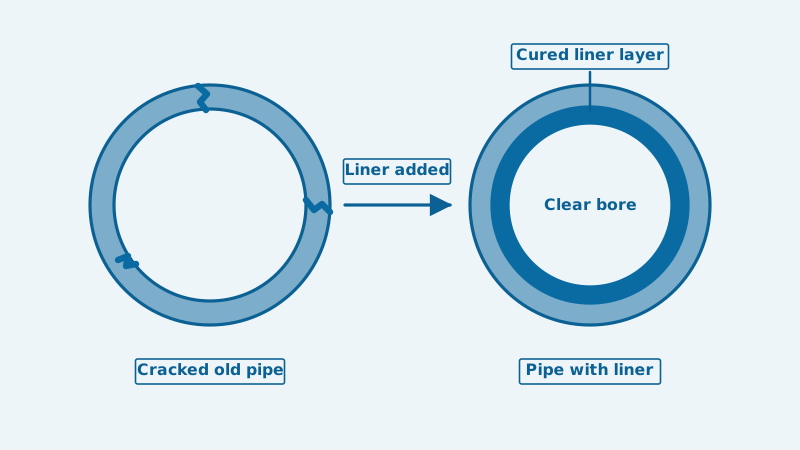
Sewer pipe lining, usually called cured-in-place pipe or CIPP, pulls a resin-soaked felt tube through your old sewer pipe, inflates it against the wall, and cures it hard. The result is a jointless pipe inside the old one. It is the main form of trenchless sewer repair, and it avoids most of the digging and surface damage of a replacement. It works only when the old pipe is open and roughly in line.
What is sewer pipe lining?
Sewer pipe lining installs a new pipe within the old one. A felt or fiberglass tube soaked in resin goes into the line, is pushed out against the walls by air or water pressure, and is cured with hot water, steam or light until it is rigid. The cure can take from one to thirty hours, depending on size and method.
The finished liner has no joints, so roots have nowhere to enter, and it resists corrosion. Where the house lateral branches, such as a tie-in from a side drain, a robotic cutter reopens the hole from inside and the opening is sealed.
Published descriptions say polyester resin is typical for main lines and epoxy for smaller laterals. Resins shrink as they cure, and epoxy shrinks far less, which matters for how well the liner fits.
It is also sold as trenchless pipe lining, and the two terms mean the same thing.
Which pipes can be lined, and which cannot?
Lining suits pipe that is still in place, round and open: clay with joints failing, cast iron with scale and cracks, and plastic with a defect. It does not suit pipe that has collapsed, flattened, or moved so far that the liner cannot pass. The camera decides, not the sales pitch.
| Pipe condition | Can it be lined? |
|---|---|
| Root intrusion at joints | Yes, after the roots are cut out |
| Hairline cracks, leaking joints | Yes |
| Rough, scaled cast iron | Often yes, after cleaning |
| A section that is offset by a large amount | Maybe, after the offset is fixed |
| A collapsed or crushed section | No, it must be dug or burst |
| A sag that holds water | Lining will follow the sag, so repair the grade first |
| Orangeburg that has flattened | Often not, since the pipe has deformed |
Orangeburg, the tar-fiber pipe used in some laterals up to the 1970s, is a special concern, since it can be oval or collapsed. If the camera shows that, replacement is more likely. See old clay sewer pipe for what the clay version looks like.
How does a sewer lining day run?
First the line is cleaned and often jetted to remove roots and scale. Then a camera confirms the pipe is clear and a measure is taken. The liner is cut to length, wet out with resin, pulled in, inflated and cured. A final camera pass shows the result, and branch openings are cut.
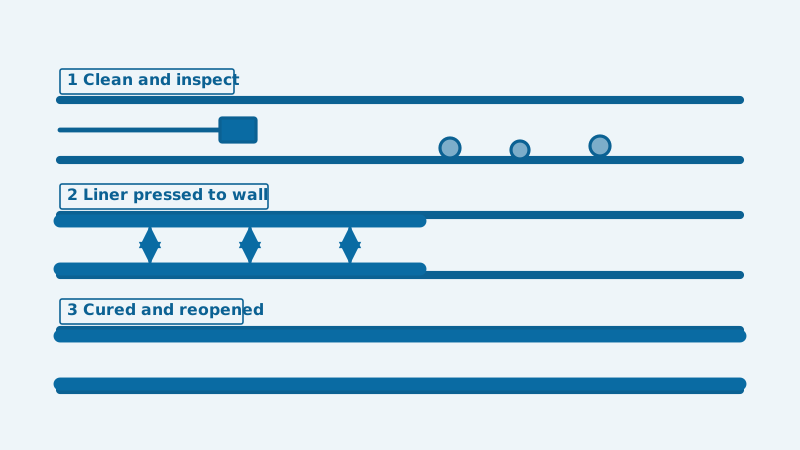
The steps in order:
- Camera and measure the line.
- Clean the pipe so the liner will stick to a clear wall.
- Cut the resin-soaked liner to length.
- Pull or invert it through the pipe from the cleanout or a small access pit.
- Cure it with hot water, steam or light.
- Cut open any branch connections.
- Camera again and keep the recording.
Plan on the water being off for part of the day, since nothing can go down the drain while the liner cures. Ask how long and when you can use the plumbing again. Our guide on how trenchless sewer repair works sets out the detail.
How long does a lined sewer pipe last?
Liners are commonly rated for 50 years or more by the businesses that install them. That is a design figure, not a promise, and the real life depends on the resin, the quality of the install and the condition of the host pipe. Ask what rating your quote is based on and what the warranty covers, in writing.
Aftercare matters. A lined pipe cannot be cleaned with cables or blades afterward, according to published descriptions of the method. High-pressure water is used instead. A camera every few years will show whether anything is going wrong.
Is sewer pipe lining cheaper than replacement?
Often, but not always. Lining usually costs less than a long trench through a driveway or landscaping, because there is little digging and surface repair. On a short, shallow run through open lawn, an open trench can cost about the same. A written quote for each method after a camera look is the only way to know.
Published figures put lining at roughly $5,000 to $12,000 for a typical lateral, and replacement at $5,000 to $15,000 or more. Our pages on sewer pipe lining cost per foot, sewer line replacement cost and pipe lining versus replacement go into the numbers.
What do Los Angeles rules say about lining a lateral?
The owner is responsible for the entire lateral, including the part under the street, according to Los Angeles County Public Works. Lining is repair work, so permits apply. Work in the public right of way needs a city permit held by a bonded sewer contractor, and work on private property generally needs a plumbing permit.
Check three things before you sign:
- That the contractor holds a California license in a class allowed to repair building sewers, and that you have checked it on the state board's website.
- That the quote lists who pulls the permits.
- That a camera pass after lining is included, with the recording given to you.
You can send a quote request, and we'll arrange a visit from a local drain cleaner who looks at the line first. You get a written price before work starts, and nothing happens until you agree. For other services, see the LA Drain Works home page.
Questions people ask
Does sewer pipe lining work on clay pipe?
Yes, it is one of the most common uses. Lining seals the joints that roots enter and the cracks that leak. The clay must be in place and open, so a camera and cleaning come first. A collapsed or badly offset section usually has to be dug and repaired before the liner goes in.
How long does sewer pipe lining take?
Most single-family laterals are lined in a day, including cleaning, the camera pass, the install and the cure. Large or long lines, or lines that need repair before lining, take longer. Curing alone can take hours. Ask for the plan for the day, including when you can use water.
Does lining reduce the size of the pipe?
Slightly. The liner has thickness, so the inside diameter is a little smaller. Because the new surface is smooth and jointless, flow is usually as good or better than the rough old pipe. A 4 inch line remains a working 4 inch line for household waste.
Can a lined pipe get roots again?
Roots cannot enter through the liner wall, and the liner closes the joints. They can still enter at the ends or at a branch connection if the seal is poor, which is why a post-install camera pass matters. Ask how the ends and branches are sealed.
Do I need to dig for sewer pipe lining?
Usually a small access pit or only the cleanout. Some jobs need a pit at one end where the line meets the street, or at a point where the pipe turns. It is far less digging than replacement, which is why the method is described as trenchless.
Sources used
- Cured-in-place pipe, method, resins, curing and limits
- Trenchless technology, overview
- Orangeburg pipe, history and failure
- Los Angeles County Public Works, Sewer: owner responsibility for the lateral
- CSLB, Building Official Information Guide, who may install or repair building sewers
- Published lining prices and service life figures from several California plumbing businesses and cost guides, checked November 2026
Page updated