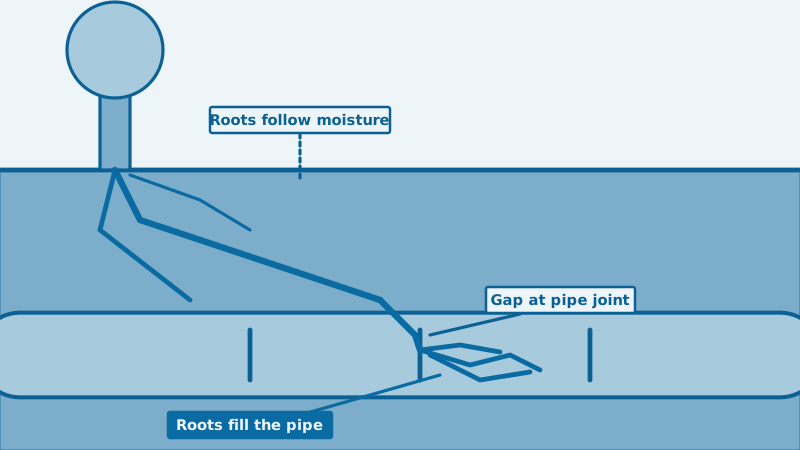
This is a product question, so here is the honest answer. Foaming root killer is a pesticide, with dichlobenil as its active ingredient, that foams through a pipe and sticks to roots so they die back. It can slow regrowth in a line that is already open. It does not open a blocked line, and it does not stop new roots from entering. For a line that is already backing up, the work is cutting the roots with a cable or a jetter, then deciding about the entry point. The page on how to get rid of roots in a sewer line covers that full process.
Does foaming root killer work?
It works on roots that are inside a pipe and in contact with the foam, usually over days or weeks. It does not cut a thick mass out of the pipe, so a line that is blocked or draining slowly needs the roots cleared mechanically first. It is a maintenance product to slow regrowth, not a rescue for a stopped line.
The label of one common product, registered with the EPA as Roebic Foaming Root Killer, names dichlobenil as the only active ingredient. It is sold in two parts that react to foam. The label's directions cover residential lines of 4 inches up to 50 feet, and it advises repeating the treatment about once a year for root control near trees. The label is a legal document, so follow it exactly, and read the current one on the product.
Roots grow back from the entry point, so the effect fades. If the pipe has a gap, roots will return to it, even if the root killer worked.
What chemical kills roots in a sewer line, and what kills them fastest?
Nothing kills roots immediately. The active ingredients in root killer products, such as dichlobenil on the label above, work over days or weeks as the roots die back and slough off. The fastest way to clear roots is mechanical: a cable with a root cutting head, or a hydro jet with a cutting nozzle. Chemicals follow to slow regrowth.
You will see lists of root killers: foam products, copper sulfate crystals and others. We do not rank them, because the right choice depends on your pipe, your septic or sewer system and the rules where you live. Check the label for the pipe material and the approved use, and keep all products away from children and pets.
There is no homemade version that is safe and reliable. Pouring household chemicals in a line can damage the pipe and make the standing water dangerous. For a deeper look at your options, see what dissolves tree roots in sewer lines, which has a fast version and a do it yourself version.
How do I know tree roots are in my sewer line?
The common signs are slow drains throughout the house, gurgling toilets, a sewer smell, a backup that clears and returns within weeks, and a lush patch of lawn over the line. Only a camera confirms it, showing fine roots threading the joints or a solid mass. Our guide to the signs of tree roots in a sewer line lists more clues.
In older Los Angeles neighborhoods, many laterals are clay with joints every few feet, and roots find those joints. A camera shows whether the roots are a light fringe at a joint or a mass across the pipe, which decides between cutting and repair. A recording also shows whether the line is cracked.
If you see a collapsed section, no root killer will fix that, and no amount of foam keeps a broken pipe watertight.
Who is responsible for roots in a sewer lateral in Los Angeles?
The owner of the property is responsible for the private lateral, according to LA Sanitation, which says the owner maintains and repairs the whole lateral, even when the roots come from a public tree. LA County Public Works takes the same view for unincorporated areas. If the roots come from a city tree, that is a separate question you can raise with the city.
That LA Sanitation guidance matters for a DIY plan. Check with the city or the person doing the work before you rely on a product for a line that is already blocked. Tree roots from a neighbor's tree and damage claims are a legal question, and a lawyer is the one to ask. Whether insurance pays for roots in plumbing depends on your policy, and many standard policies do not cover the lateral itself.
What actually stops roots coming back?
Fixing the entry point. A spot repair, a liner or a replacement of the damaged section closes the gap, and roots cannot enter a sealed pipe. Cutting and foam give months, not years, so a line that needs yearly clearing is usually cheaper to repair than to cut each time.
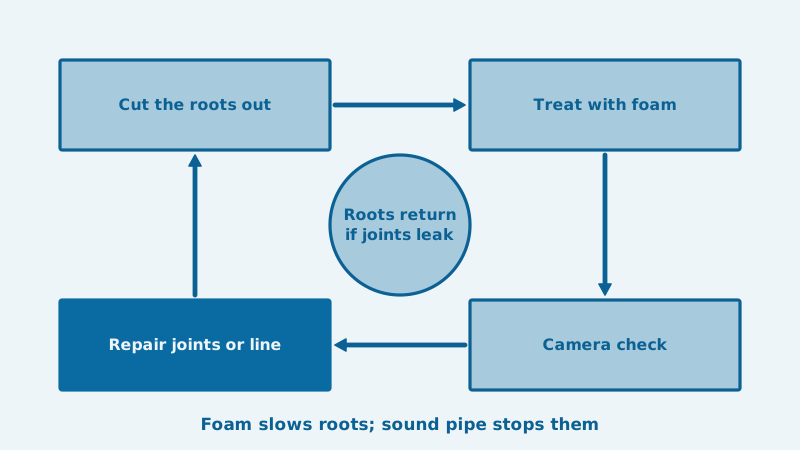
Published guides put root cutting at roughly $150 to $500 on top of a cleaning, with regrowth often in 6 to 12 months. A spot repair is costed per case, and a liner is priced per foot. Read prevent tree roots in a sewer line for what you can do about the tree and the pipe.
Planting matters too. Large, thirsty trees close to a lateral are a common source of roots, so check before you plant and keep big trees well away from the line.
What does root removal cost in Los Angeles?
National 2026 guides put root removal at about $100 to $600 on top of a drain cleaning, with snaking at $200 to $500 and hydro jetting at $600 to $1,400 in one guide and $350 to $900 in others. Professional foam treatments are reported around $100 to $300. West Coast prices tend to run higher, and the written quote after a visit is the real price.
See roots in pipes removal cost for more detail. For comparison, hydro jetting is covered on our hydro jetting drain cleaning page.
You can send a quote request, and we arrange a local drain cleaner who gives a written price before work starts. Nothing is done until you agree. The LA Drain Works home page lists the other services.
Questions people ask
Does foaming root killer work?
It can kill roots it touches inside the pipe over days or weeks, but it will not clear a blocked line and it does not stop new roots entering. Use it as maintenance after the line is cleared. If roots return within months, the pipe has a gap that needs repair.
What is the strongest tree root killer?
There is no single strongest product for every pipe. Strength matters less than fit: the label sets pipe type, line length and how often you apply it. Mechanical cutting is faster than any chemical. Read the label, follow it and ask a professional about stubborn roots.
Can roots damage my sewer line?
Yes. Roots enter through cracks and joints, thicken inside, and can crack the pipe further. In clay pipe, joints are common entry points. A camera look after a backup shows whether roots are the cause and whether the pipe is damaged.
Can I make homemade root killer?
We do not recommend it. Household chemicals can damage pipes, react dangerously with each other and leave standing water hazardous. If you want a product, use one registered for the purpose and follow its label. For stubborn roots, cutting and repair are the real fixes.
Will homeowners insurance cover tree roots in plumbing?
It depends on the policy. Many standard policies do not cover the lateral itself, and backup damage may need an endorsement. Ask your insurer before work starts and keep a camera recording. Our guide to sewer backup insurance coverage explains the usual wording.
Guides in this section
- How to get rid of roots in a sewer line
Cut roots out of a sewer line, slow regrowth with root killer, and fix the opening so they stay out.
- Prevent tree roots in sewer line
Keep roots out of the sewer line: choose and place trees well, seal joints with lining, keep the line maintained, and know the Los Angeles…
- Root removal cost
Clearing tree roots from a Los Angeles sewer line costs about $350 to $1,100, and more if the pipe is damaged.
- Signs of tree roots in sewer line
Gurgling, slow drains, a sewer smell or lush patches in the yard can mean roots in the sewer line.
- Dissolving tree roots
What dissolves tree roots in a sewer line?
Sources used
- US EPA, pesticide product label, Roebic Foaming Root Killer (EPA Reg. No. 7792-7)
- LA Sanitation, managing and protecting LA's underground sewer system
- Wikipedia, dichlobenil
- HomeGuide, how much does sewer line cleaning cost (2026)
- Published 2026 price guides for root cutting and sewer line repair, checked November 2026
Page updated