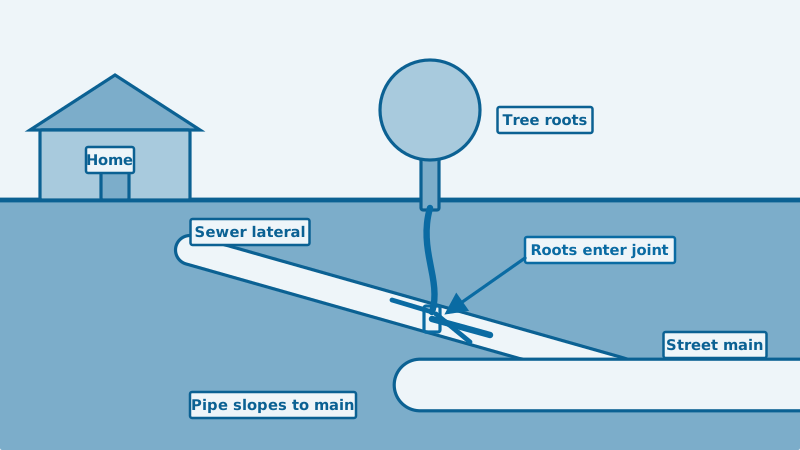
Roots are cleared by cutting them out with a rotating blade or a high-pressure water jet, then slowed with a root killer, then kept out for good by repairing the joint or crack they entered. Cutting alone gives you weeks to a few years of relief, depending on the tree. Our guide to foaming root killer covers the chemical side in detail. Below is the full picture, in the order you would work through it.
How do tree roots get into a sewer line?
Tree roots get into a sewer line through cracks, loose joints and worn spots in the pipe. Roots grow toward moisture and nutrients, and a sewer pipe leaks small amounts of both. A hair-thin root enters the opening, then thickens inside the pipe and catches paper and grease, which builds a clog.
Roots do not break a healthy, sealed pipe. They exploit what is already there:
- Joints. Clay pipe is laid in small lengths, and every joint is a gap. A joint can shift or open with age, soil movement and the pull of roots.
- Cracks. Old cast iron and clay crack with age. Orangeburg, a fiber pipe common until the 1970s, tends to fail early.
- Poor repairs. A badly set patch or a loose coupling can be the opening.
Roots do not need a big hole. A root as thin as a thread can get through and grow into a mass thick enough to block the flow. Root intrusion is a common cause of repeat sewer backups in older properties, including older Los Angeles homes. The camera shows them clearly: a fringe of roots hanging from a joint.
How do you remove tree roots from a sewer line?
You remove roots from a sewer line by cutting them. A cable machine with a root-cutting head, or a hydro jet with a rotating nozzle, shreds the roots and clears the pipe. A hand snake will punch a hole through a root mass but will not clear it. Either way, the pipe is open for now, not fixed.
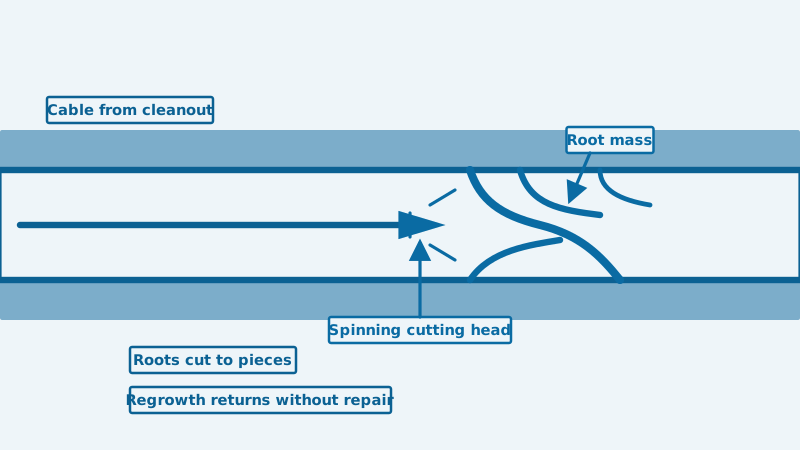
The usual options, from smallest to largest:
- A cable machine with cutting blades. A power cable spins a cutter head through the roots. It restores flow quickly. A pro uses blades sized to the pipe, because aggressive cutting can scratch old clay or cast iron.
- Hydro jetting with a root nozzle. High-pressure water cuts the roots and flushes the pieces out. It cleans more of the wall than a cable does. See hydro jetting drain cleaning.
- A hand auger. Fine for a few thin roots at an open cleanout. It will not clear a thick mass.
Machines used on a sewer lateral are heavy, and the cable can whip back. This is why root cutting is usually a job for a drain cleaner, not a rental. If you own the property in the City of Los Angeles, the private lateral is yours end to end, so the cutting and any later repair are yours to arrange. See main line drain cleaning for how a clearing visit runs.
What dissolves tree roots in sewer lines?
Foaming root killers and copper sulfate crystals kill the roots they touch, but nothing dissolves a solid root mass quickly. Treated roots die and break off over days to weeks, and the dead pieces still need flushing out. These products slow regrowth. They do not repair the opening.
What each does, with its limits:
- Foaming root killer. It foams through the pipe and coats the walls with a herbicide. It reaches roots a cable might miss. It does not remove dead roots, and most products are reapplied every six months to a year.
- Copper sulfate crystals. Poured into the toilet nearest the line, they kill roots that touch them. Some places restrict copper sulfate, and it harms the bacteria in a septic system, so read the label and local rules.
- Home remedies. Rock salt, vinegar and baking soda are often named online. They are not designed to kill roots, and they do not work reliably.
Follow the label exactly, wear gloves and eye protection, and never mix products. Tell any plumber what you used. For a longer look at what dissolves roots and what only seems to, see what dissolves tree roots in sewer lines.
How do you remove tree roots from a sewer line permanently?
You can only keep roots out by closing the opening they entered. That means a spot repair of the joint, a liner inside the old pipe, or replacing the section or the whole line. Cutting and chemicals clear roots; a repair stops them returning. Without it, expect them to come back.
The permanent options, in the order most contractors suggest:
- Camera first. A recording shows where roots enter and how much of the pipe is damaged.
- Spot repair. If one joint or section is the problem, a short dig and a new piece can solve it.
- Liner. A cured-in-place liner seals joints and small cracks from inside. It must go in after the roots are cut out. See pipe lining versus replacement.
- Replacement. If the pipe is badly damaged, replacing it, by trench or by pipe bursting, removes the old weak joints.
Removing the tree is not an automatic fix. Roots can stay alive for years after a tree is cut and keep growing toward the pipe. Some native trees in the City of Los Angeles, including oaks (except scrub oak), Southern California black walnut, California sycamore and bay laurel, are protected once they reach at least 4 inches across, and a city permit is needed to remove one or to do work that may kill it, which can include cutting its roots. Do not cut roots of a street tree without the StreetsLA permit. Check with the city before cutting anything. If a street tree or a neighbor's tree is involved, that adds another party.
For a deeper look at the cost of clearing roots, see roots in pipes removal cost.
When should you call for help with roots?
Call when the clog returns within weeks, when a camera shows roots at several joints, or when water backs up into the house. Roots in a line are a sign the pipe is open, and the backups tend to get worse. A clearing now and a repair plan later is the usual order.
Signs that point to roots specifically: repeat backups that clear and return, slow drains across the house, gurgling, and wet patches along the line. For a written price on cutting roots and checking the pipe afterward, go to the quote page and we'll arrange a local drain cleaner to visit. The LA Drain Works home page lists the services we cover.
Questions people ask
How often do roots grow back in a sewer line?
It varies. Roots cut out of a line with an open joint can return in weeks to a couple of years, depending on the tree, the soil moisture and the opening. A root killer applied after cutting can lengthen that. Only repairing the opening stops it, so plan on a camera check every year or two if the pipe is old.
Will root killer damage my pipes?
Used as the label says, foaming root killers are made for sewer lines. Copper sulfate can corrode some metals over time and harms septic bacteria. Never mix products or pour them into a line that is already backing up. When in doubt, ask a plumber before treating an old cast iron or clay pipe.
Can I use a drain snake to remove roots?
A hand snake can poke through a thin root mass and restore a trickle, but it does not remove the roots, and the hole often closes again. A cutter head on a power cable does the job properly. Do not force a hand snake, since it can catch in old pipe.
Do roots mean my whole sewer line needs replacing?
Not always. Roots mean the pipe has an opening, but that may be a single joint. A camera shows how many joints are affected and the condition of the pipe. A spot repair or a liner can be enough, and a full replacement is for badly damaged pipe.
Sources used
- LA Sanitation, managing and protecting LA's underground sewer system
- LA County Public Works, private sewer laterals and homeowner responsibilities
- StreetsLA, Los Angeles protected trees photo guide
- Cured-in-place pipe, method and limits
- Published guidance of several plumbing businesses on root removal, checked November 2026
Page updated