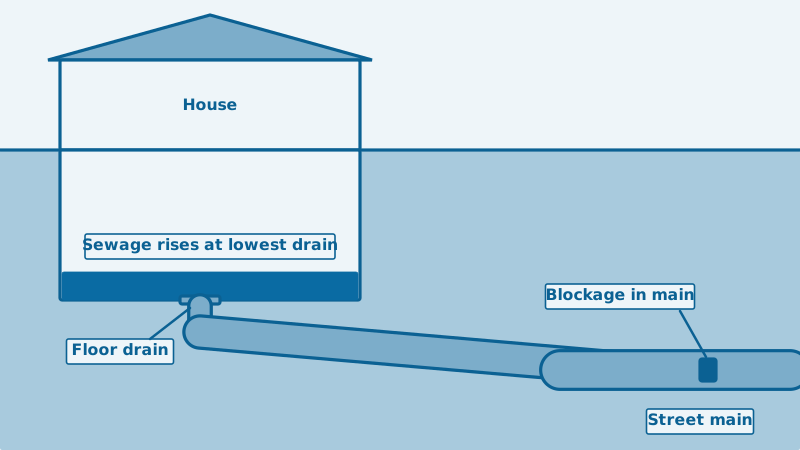
A sewer backup into a basement happens when wastewater has nowhere to go in the main sewer line and rises out of the lowest drain. Basements and lower levels are the most exposed, because they sit below the rest of the plumbing and often below the street's sewer cover. The fix starts with clearing the line, covered in our guide to main line drain cleaning.
What causes a sewer backup in a basement?
Most basement backups come from a blockage in your own lateral or in the city main: tree roots, grease, wipes, or a damaged pipe. When the sewer is blocked or overloaded, wastewater rises to the lowest opening. A house whose lowest drain sits below the manhole cover on the street is at higher risk, because gravity is on the water's side.
The common causes:
- Roots entering joints in the lateral, especially in older clay pipe.
- Grease and paper building into a dam.
- A damaged or collapsed pipe where solids catch.
- A blockage in the city main, which affects the whole street.
- Heavy rain, which can add to flow in the public sewer in areas where stormwater gets in.
LA Sanitation says that more than half of the backups it sees come from roots and from fats, oils and grease. Camera inspection shows which one you have, and our page on signs of tree roots in a sewer line lists the clues.
Do Los Angeles homes have basements, and does it matter?
Many Los Angeles homes have no basement, so the lowest drain is a tub, shower or garage floor drain. Some older houses, hillside homes with lower floors, and multi-unit buildings have lower levels or basements. The same rule applies to any of them: a drain below the street manhole cover is at risk. We do not have a count of Los Angeles homes with basements.
What matters is the height of your lowest fixture compared to the sewer manhole upstream of your house. LA Sanitation says that if the lowest plumbing fixture, such as a basement tub or shower, is lower than the street manhole cover, the property needs a backwater valve, which requires an LADBS permit. The California Plumbing Code (section 710.1) sets the same rule for fixtures below the next upstream manhole cover. Ask a plumber to check yours, because an older house may predate the rule.
How do you clean a basement after a sewer backup?
Stop the source first, then wear boots, gloves and eye protection, remove and throw out porous items that sewage soaked, wash hard surfaces with hot water and detergent, disinfect, and dry the space within a day or two. CDC guidance says drywall and insulation that sewage reached should be removed. A basement holds moisture, so drying matters most.
Basements add two problems. Moisture lingers because air does not move, so run fans and a dehumidifier. And concrete is porous, so a slab that sewage soaked may need professional cleaning. For larger spills, a restoration business is the safer call, and our full sequence is in cleaning up a sewer backup. Photograph everything before you move it, because an insurer will ask.
What is the best way to unclog the main sewer line?
The best way is a motorized cable or hydro jet run through the cleanout by a plumber, followed by a camera pass. Cable cuts a path through roots and soft clogs. A jet cleans the pipe wall. Poured cleaners and small hand augers rarely work on a main line, which is long and carries a lot of water.
Snaking the main drain line is the usual first step. The plumber feeds a powered cable from the cleanout toward the street, cuts or pushes through the blockage, then flushes. Published Los Angeles prices run roughly $150 to $600 for cable work and $300 to $1,000 for a jet. See our main sewer line clog cost page for the full range.
If sewage is already in the basement, call at once. The longer the water sits, the more it ruins.
What is the best chemical or cleaner for a main drain line?
There is no good chemical fix for a full main line. Caustic and acid products need to sit on a clog, but a main carries a heavy flow that dilutes them and sends them downstream. Foaming root killers and enzyme products help with maintenance after a line is open, not with a backup that is happening now.
If you are asking where to pour a main line cleaner, the honest answer is that a cleaner poured down a toilet or tub rarely reaches the clog, and if the line is full it will sit in the sewage in your house. Many cleaners are hazardous if a plumber's cable splashes them. Our page on the best chemical to unclog a sewer line explains the products, and foaming root killer covers the one type that does help.
Do plumbers clean out drains, and does a sink drain need a cleanout?
Yes, plumbers clean out drains with cables, jets and cameras. A sink drain does not need its own cleanout in most homes, because the sink's trap and the line's cleanouts give access. The cleanout that matters is the one on the main sewer line, outside or in the lowest part of the house.
A cleanout lets a plumber reach the line without pulling a toilet. LA County Public Works recommends installing a backflow preventer and a cleanout on your sewer lateral. If your basement has a floor drain, it may serve as an access point too, but it is a poor one: it can be small, and pushing a cable through it risks splashing. Ask a plumber where the best entry is.
How do you stop a sewer backup in the basement from happening again?
Clear the cause, then add protection: a backwater valve on the line, a cleanout for fast access, a root control plan if roots caused it, and plugs or covers on floor drains. A backwater valve lets wastewater leave the house but blocks flow from coming back in. It needs a permit and a plumber.
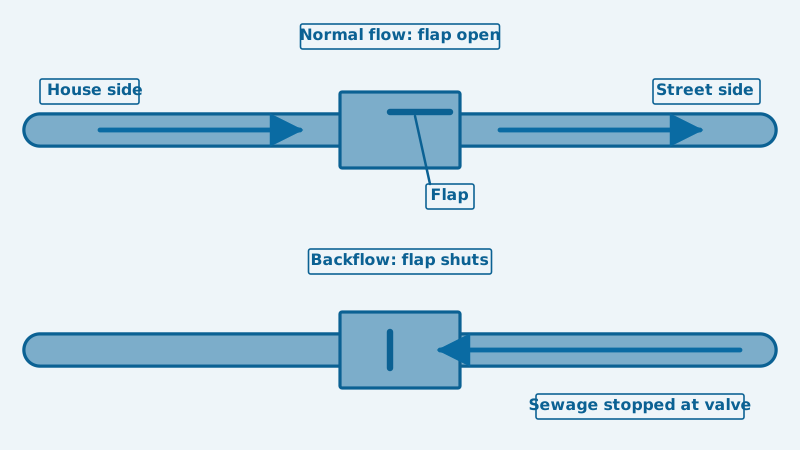
Our guide to preventing sewer backup lists the steps, and the page on floor drain plugs covers the cheap part. Valves need an occasional check, since debris can keep a flap from closing.
What is water sewer backup coverage, and will insurance pay for a basement backup?
Water backup coverage is an optional add-on to a homeowners policy. Standard California homeowners policies generally exclude sewer and drain backup, and the add-on, if you have it, may pay for damage inside the home, usually up to a stated limit. Read your policy and ask your insurer, because wording varies.
The California Department of Insurance lists sudden and accidental water damage among covered perils, and flood damage among the exclusions. Read your policy's exclusions, and if a claim is denied, the California Department of Insurance says the denial must be in writing with reasons and that it can review a claim you believe was wrongly denied. The detail is on our page on whether home insurance covers sewer backup. The add-on does not cover the pipe itself.
If you want a plumber and a camera pass, request a written price. Our home page lists what else we arrange.
Questions people ask
Can a city sewer backup into a basement?
Yes. If the city main is blocked or overloaded, wastewater can rise through any drain lower than the manhole cover. If the neighbors are affected too, call LA Sanitation at 1-800-773-2489. If only your house is affected, the problem is probably in your own lateral.
How long does it take to clear a main line that backed up a basement?
A plumber can often clear the line in one to two hours, and a camera pass takes about 30 minutes more. Drying and cleanup take longer, often several days, depending on how much sewage entered and what it touched. A larger spill or a finished space can double that.
What should I ask before I hire someone for a basement sewer backup?
Ask for the price in writing, whether a camera pass is included, what tool they will use, and which CSLB classification they hold. Ask if they can also check whether a backwater valve is needed. Keep the video for any insurance claim.
Do I need to be home for a sewer backup visit?
Someone should be there to let the plumber in, point out the cleanout and the lowest drain, and approve extra work. You will also want to see the camera footage. Agree the arrangement when you book. If you cannot be there, ask a trusted adult to meet the plumber.
Sources used
- LA Sanitation, Managing and Protecting LA's Underground Sewer System
- Los Angeles County Public Works, Sewer
- California Plumbing Code section 710.1, backwater valves, as summarized by LA County Public Works and LA Sanitation
- California Department of Insurance, Residential Insurance: Homeowners and Renters
- CDC, Guidelines for Cleaning Safely After a Disaster
- Drain cleaner, safety and chemistry
- Published prices of Los Angeles drain cleaning businesses, checked November 2026
Page updated