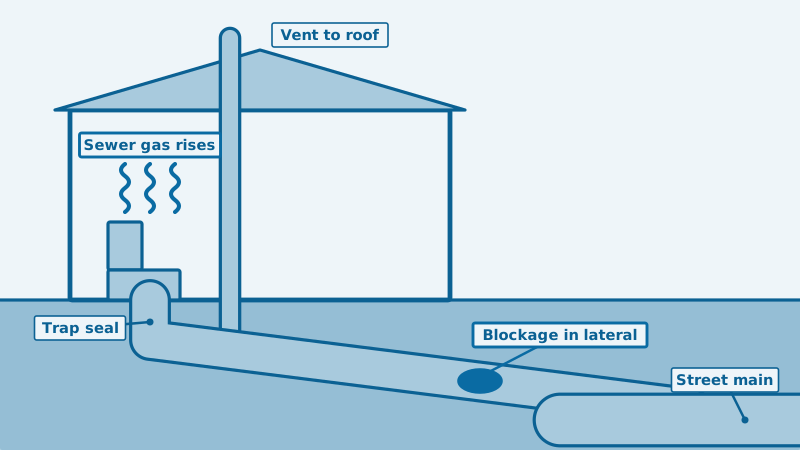
A sewer smell that hangs in the whole house, not just one bathroom, is a different problem from a stale drain. One fixture smelling usually means a dry or dirty trap. Several rooms smelling, especially with slow drains or gurgling, usually means the main sewer line is partly blocked or broken somewhere between your house and the street. This page covers the signs, a simple test to rule out the easy causes, and what happens next. If you are comparing it with the wider picture, start with our main line drain cleaning page.
What are the symptoms of a clogged main sewer line?
The main sewer line carries everything from the house out to the city sewer. When it clogs, every fixture feels it. The usual signs are several slow drains at once, a sewer smell in more than one room, gurgling from toilets or floor drains, and water or sewage coming up in the lowest drain in the house.
Look for the pattern, not a single symptom:
- The toilet gurgles when the washing machine drains.
- The shower and the floor drain both back up when someone flushes.
- Water rises in the bathtub while the toilet is flushed.
- A smell appears outside near the cleanout cap or the front yard.
- A snaked drain clogs again within days or weeks.
One slow sink on its own is almost always a branch line problem. Three fixtures acting up together is the main line until a camera says otherwise.
How do you tell a main line smell from a dry trap?
Run water for a minute in every drain you rarely use, including the guest bathroom, the laundry sink and any floor drain, then check whether the smell fades. If it does, you had a dry trap. If the smell stays, or other drains gurgle while you do it, the cause is further down the line.
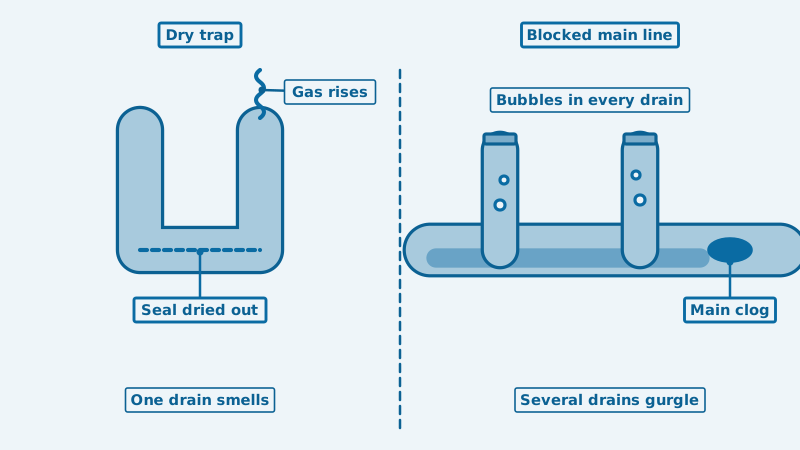
Every fixture has a U-shaped trap that holds water and blocks gas from the pipes. Traps in rarely used rooms dry out, which is common in a spare bathroom. The California Plumbing Code requires traps and, for floor drains used infrequently, a trap seal primer, because a dry seal lets sewer gas into the building. If you want the fixture-by-fixture fixes, we cover them separately in what to do about a sewer drain smell at the fixture.
A quick comparison:
| What you notice | Likely cause |
|---|---|
| Smell in one bathroom only, fades after running water | Dry trap |
| Smell near one drain, gurgling at that drain | Partial clog in that branch |
| Smell in several rooms plus slow drains | Main line restriction |
| Smell plus water or sewage at the lowest drain | Main line blocked |
| Smell in the yard near the cleanout or street | Cracked or broken lateral |
Is a sewer smell in the house dangerous?
A faint, short-lived sewer smell is usually an annoyance, not an emergency. Sewer gas is a mix of gases, and hydrogen sulfide is the one you smell. The Illinois Department of Public Health says you can smell hydrogen sulfide at lower levels than may cause health effects, so a smell alone does not mean you are being harmed.
Do not ignore a strong or growing smell. Open windows, keep the room ventilated, and leave the house if anyone feels dizzy, faint, or has trouble breathing. Call 911 in that case. The same fact sheet says that at higher levels your nose can become overwhelmed, so a smell that seems to fade is not proof the air is safe.
One more check: a rotten-egg smell can also be natural gas, which utilities scent on purpose. If you cannot trace the smell to a drain, do not flip switches or use flames, leave the house and call 911 or your gas utility from outside.
What causes a main sewer line to smell or back up?
Most main line smells come from a partial blockage or a broken pipe that lets gas and waste escape. The common causes are tree roots entering the joints, grease and wipes building up, a sagging section that holds water, and old pipe that has cracked, offset or collapsed.
In Los Angeles, the pipe material matters. Many older homes were built with clay, cast iron or Orangeburg pipe. Orangeburg is a bituminous fiber pipe that was widely used in the mid twentieth century and stopped being installed in the early 1970s. It was sold with a long life, but it softens and deforms over time, and roots find it easy to enter. We cannot tell which material you have from a smell, so a camera inspection is the only reliable way to know.
Typical causes, roughly in the order drain cleaners find them:
- Roots growing into a joint, usually in clay or cast iron.
- Grease, wipes and paper catching at a rough spot or a low spot.
- A belly, where the pipe has sunk and holds standing water.
- A crack or offset joint that allows soil and gas to move in and out.
- A collapsed section, most often in very old fiber or clay pipe.
Who is responsible for the main line in Los Angeles?
In the City of Los Angeles, you own the private sewer lateral, the pipe that links your house to the public sewer in the street. LA Sanitation maintains the public main; the lateral serves one property, so keeping it clear and repairing it falls to the owner, including any stretch under the sidewalk or street.
The same principle applies in unincorporated Los Angeles County. LA County Public Works says the property owner is responsible for the entire length of the lateral, including the part under the street, and that the owner must keep it free of roots and grease. If a blockage is in the public main, the agency handles it. A plumber can usually tell you in one visit which side the problem is on.
Work on a lateral also needs permits. Repairs on your own property typically go through the Department of Building and Safety, while work in the street or sidewalk is a separate Bureau of Engineering permit. We'll arrange a local plumber who deals with this regularly, and the quote should say who pulls what.
What should you do right now?
Stop using water as much as you can, especially the toilet, washing machine and dishwasher, because every gallon that cannot leave the house has to go somewhere. Open windows, keep people and pets away from any backed-up fixture, and find your cleanout cap if you know where it is. Do not pour drain cleaner into a suspected main line clog.
Chemical cleaners rarely clear a main line, and they leave caustic water sitting in the pipe that the person clearing it then has to work around. They can also damage old pipe. If sewage has already come up indoors, avoid touching it and keep children away; it is a contamination issue, not just a mess.
A short checklist for the next hour:
- Note which fixtures are slow, gurgling or smelling.
- Note when it started and whether rain or heavy water use made it worse.
- Take a photo of any standing water or sewage.
- Look for the cleanout, often a capped pipe in the front yard or along the side of the house.
- Schedule service online so someone can run a camera down the line.
How does a drain cleaner find the cause?
A good visit starts with a camera. A technician feeds a small waterproof camera down the cleanout to see roots, grease, cracks and sags on screen, and then clears the line with a cable or a hydro jet, depending on what is there. Roots and grease respond to different tools, so the cause drives the method.
If the camera shows a collapsed or badly cracked section, clearing it will not fix the smell, and the quote moves to repair. That can mean spot repair, lining or replacement, covered in sewer line repair and trenchless options. A written quote comes before any work starts, and you should get the camera footage so you can see what the problem is.
For a closer look at your own situation, you can also read about emergency sewer backup help if the water is already coming up.
Ready to find out what is behind the smell? Send the details on our price request page and we'll arrange a visit. You can also go back to the LA Drain Works home page to see everything we cover.
Questions people ask
How long does it take to find a sewer smell in the house?
Checking traps takes minutes. Tracing a main line cause usually fits in one visit, since the camera run often takes under an hour and a blockage can often be cleared the same day. A broken pipe is a bigger job that depends on permits, depth and access, so the written quote should carry a realistic schedule.
What should I ask before I hire someone for a sewer smell?
Ask whether the price includes the camera and a copy of the footage, which method they plan to use and why, and whether a permit is needed. Also ask what happens if the camera finds a broken pipe. Get the quote in writing, and be wary of a repair price given without anyone looking inside the line.
Do I need to be home for the visit?
Someone should be there at the start so the plumber can reach the cleanout and see which fixtures misbehave. If the cleanout sits behind a locked gate or in the crawlspace, tell us beforehand. An adult who can approve the quote should stay reachable by phone for the rest of the visit.
Can a sewer smell go away on its own?
A dry trap smell goes away once you refill the trap. A smell caused by a partial main line clog usually returns, often louder, because the cause has not changed. If it fades for a day and comes back with slow drains, treat it as a main line warning and have it checked.
Is a sewer smell covered by home insurance?
Many standard policies exclude sewer backup unless you add a rider, and the terms differ by insurer. Check your policy before you need it. A written camera report helps if you ever make a claim, so ask for the footage whatever the outcome.
Sources used
- Illinois Department of Public Health, hydrogen sulfide gas fact sheet
- LA County Public Works, sewer lateral customer information
- LA Sanitation, managing and protecting LA's underground sewer system
- APWA Minnesota Chapter, The Rise and Fall of Orangeburg Pipe
- Published guides from Southern California drain cleaning businesses, checked November 2026
Page updated