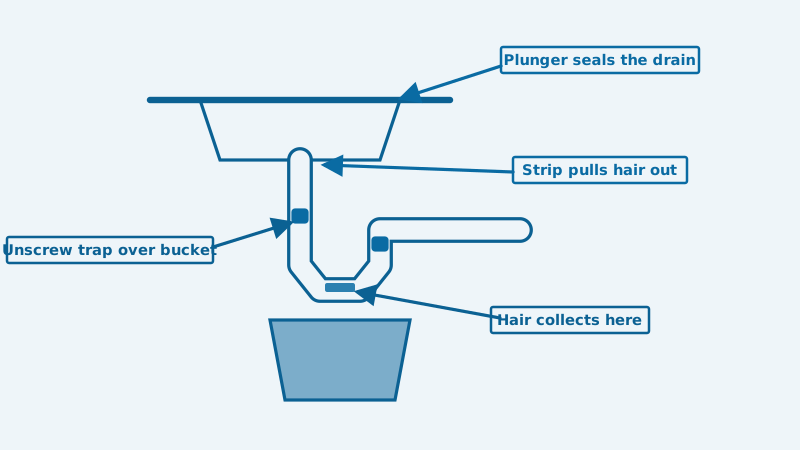
The most effective non-toxic way to clean a drain is mechanical: a plunger, a barbed plastic strip, a hand auger or, for deeper lines, a professional machine or water jet. Gentler options such as hot tap water, enzyme products and baking soda with vinegar help with light buildup, but they do not clear a solid blockage. The LA Drain Works home page lists what we arrange when home methods run out.
What does "non-toxic" mean for a drain cleaner?
There is no single legal definition that a buyer can rely on. A bottle labeled non-toxic or natural may still irritate skin and eyes, so check the safety data on the label. What matters is how the product works: some attack the clog chemically, others break it up or lift it out physically.
Wikipedia describes commercial chemical openers as usually containing corrosive acids or alkalis, which attack proteins, fats and carbohydrates. Sodium hydroxide, or lye, turns grease into soap and can cause chemical burns and permanent blindness on eye contact. Many drain cleaners are strong alkalis and very caustic.
A safer drain method keeps those chemicals out of the picture. Mechanical tools do the job without a reaction, and enzymatic cleaners rely on biology. The trade-off is speed and strength, and the sections below show where each fits.
Which non-toxic methods actually clear a clog?
Mechanical tools clear the most. A plunger moves a blockage that is close to the drain, a barbed strip pulls out hair and a hand auger bores through a soft clog further down. Hot tap water helps with light grease. Enzyme products and baking soda with vinegar help with film, not plugs.
| Method | Clears | Does not clear | Safety |
|---|---|---|---|
| Plunger | Clogs near the trap | Deep or hard blockages | Safe |
| Barbed strip or hook | Hair mats at the top | Anything past arm's reach | Safe |
| Hand auger (1/4 inch) | Soft clogs in sinks, tubs, showers | Roots, collapsed pipe | Safe if used gently |
| Hot tap water | Light grease films | Hair, solid plugs | Safe |
| Enzyme cleaner | Light organic film over time | Hair, tight plugs | Gentle, slow |
| Baking soda and vinegar | Light odor and film | Hair, real clogs | Safe |
| Professional jetting | Grease, scale and roots in lines | Broken pipe | Done by a professional |
If you are unsure, start at the top of the table and work down.
Does baking soda and vinegar work as a drain cleaner?
It freshens a drain but it rarely clears a clog. Baking soda is a mild base and vinegar is a mild acid. Together they fizz, and the bubbling can loosen a thin film. Wikipedia describes sodium bicarbonate as a mild base that reacts with acids. It does not break up hair or a grease plug.
How to use it: pour half a cup of baking soda into the drain, add a cup of white vinegar, cover and wait ten minutes, then flush with hot tap water. It suits a drain that smells or runs a bit slow. If the water has not improved after one try, the clog needs a tool.
Do not follow it with a commercial cleaner. The rule is simple: never mix cleaning products.
Are enzyme and bacterial drain cleaners worth using?
They suit prevention more than rescue. Enzymatic cleaners use enzymes to break organic matter into smaller, water-soluble molecules, Wikipedia says, and they are more gentle on pipes and skin. They work slowly, often overnight, and may not suit a severe blockage.
Use one to keep a kitchen line free of film, or when you have a slow drain with no hair involved. Follow the label, avoid mixing with other products and give it the full time. Expect no change on hair or a solid plug.
Claims vary between brands, and no single test covers them all. Treat marketing about "dissolves anything" with caution, and judge by whether the water drains faster after a fair trial. If it does not, move to a tool.
Is boiling water a safe way to clear a drain?
Hot water helps with light grease, but boiling water is a bad idea for many home drains. Charlotte Pipe lists 140 degrees Fahrenheit as the maximum working temperature for PVC, and a kettle comes in at 212. Hot water from your tap, from the water heater, is a safe alternative.
Pour it slowly into the drain rather than all at once, and run the hot tap for a minute afterwards. For a cast iron line, boiling water is less of an issue, but it will not clear anything more than grease.
Another caution: melted fat can move farther down the line and set again. If the kitchen drain slows again in a day or two, the grease is likely somewhere beyond the trap, and a machine or jetting is a better answer. See hydro jetting for how that works.
When does a non-toxic method stop working?
When the clog is beyond reach, when it keeps coming back, or when more than one fixture is slow. At that point the cause is a shared branch line or the main line, and home tools or gentle products will not reach it. Tree roots and grease are common culprits, and older homes in the city are more likely to have roots in the lateral. The warning signs are gurgling, slow fixtures in several locations and a sewer smell.
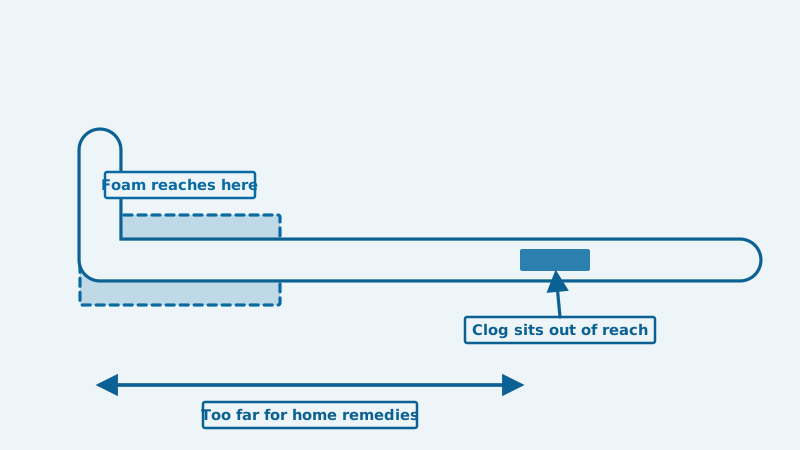
The city's sanitation agency puts roots and poured grease behind over half of sewer backups, and property owners are responsible for the entire private sewer lateral from the building to the street. Roots in a clay pipe will not respond to a plunger or to vinegar. A camera shows what is there; read about sewer camera inspection.
An old clay pipe that has cracked or offset is a repair or lining question rather than a cleaning one. Our page on old clay sewer pipe covers the signs.
How do I dispose of leftover drain cleaner safely?
Do not pour it down a drain or into the trash. LA Sanitation runs S.A.F.E. centers for household hazardous waste, and residents of Los Angeles County can use them for free. Check the accepted items list and opening hours on the official page before you go.
If you have an old bottle of lye or acid drain cleaner under the sink, that is a good reason to switch to the methods above. Keep it in its original container, upright and away from other products, until you can drop it off.
For more safe approaches to home clogs, see DIY drain cleaning and our clogged drain home remedies page.
When should I call a professional instead?
If sewage is coming up, ask for emergency service rather than waiting. Otherwise call when a plunger and a hand auger have not worked, when several fixtures are slow, when you hear gurgling, or when sewage smells persist. A professional can use a longer cable, a water jet or a camera, none of which needs strong chemicals.
We'll arrange a local drain cleaner who works with cables and jets rather than caustic liquids, with a written quote beforehand. To start, send a price request and say which drains are slow and what you have tried.
Questions people ask
What is the best non-toxic drain cleaner?
A plunger and a hand auger are the best non-toxic tools, because they remove the clog rather than dissolve it. For a light film, enzyme products or baking soda and vinegar may help. For deep or repeated clogs, a professional machine or water jet is the safest strong option.
Do natural drain cleaners really work?
For light buildup and smells, sometimes. They do not clear hair mats or grease plugs, and results are slow. Think of them as maintenance, not rescue. If a natural product does not improve the drain after one fair try, switch to a tool rather than repeating it.
Is Dawn dish soap a good drain cleaner?
A squirt of dish soap with hot tap water may loosen a light grease film, and some people find it helps. It will not clear hair or a solid clog. There is no strong evidence it does more than a hot-water flush, so do not rely on it for a real blockage.
Can I use a non-toxic cleaner on a main sewer line?
Not effectively. A product poured into a sink or toilet is too diluted by the time it reaches a main line, and it cannot dislodge roots or a collapsed section. Main line clogs need a machine, a water jet or a camera. Our main line drain cleaning page explains.
What should I ask a drain cleaner who avoids chemicals?
Ask which non-toxic method they will use, whether the price includes a cable run or a water jet, and whether you get a written price before work starts. Ask what happens if the drain slows again within a few days. A clear answer shows they know the work.
How do I choose between a plunger, an auger and a professional?
Choose by location. A plunger suits a clog right at one fixture, an auger suits a soft clog a few feet down, and a professional suits anything shared, repeated or out of reach. If you see warning signs such as gurgling or sewage smell, skip straight to a visit.
Sources used
- Wikipedia, drain cleaner (enzymatic and hydro-mechanical cleaners)
- Wikipedia, sodium hydroxide
- Wikipedia, plumber's snake
- Poison Control, household product safety, 1-800-222-1222
- Charlotte Pipe, PVC maximum working temperature (140 F)
- LA Sanitation and Environment, S.A.F.E. centers for household hazardous waste
- LA Sanitation and Environment, protecting the city's sewer system
Page updated