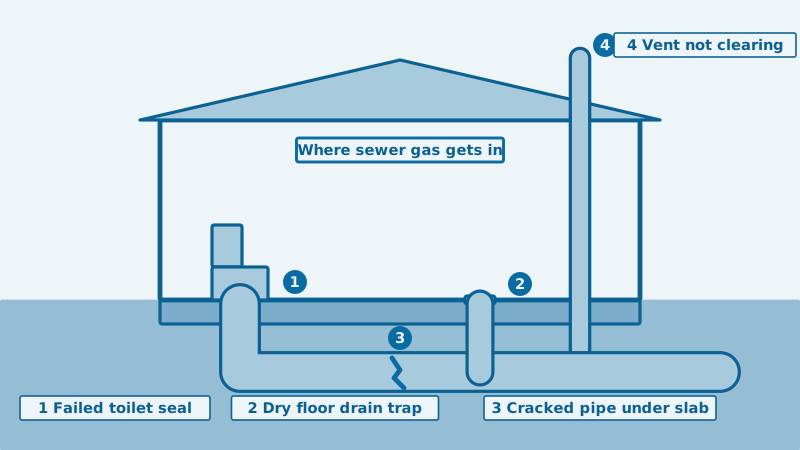
A house smells like sewer because gas from the drainage system is getting past a water seal, a vent or a damaged pipe, or because something rotting sits in a drain. Which room smells strongest, and when, tells you most of it. A smell in one bathroom is usually local. A smell everywhere, or a smell with slow drains, points at the line. The drain cleaning home page explains how a visit works if you want one arranged.
Why does it smell like sewer in my house?
It smells like sewer because drain traps, the water-filled bends under fixtures, normally block gas from the pipes. When a trap dries out, a vent is blocked, a seal fails or a pipe leaks, gas comes into the room. A trap that has not been used for a few weeks is the most common and cheapest cause.
Sewer gas is a mix of gases, with hydrogen sulfide giving the rotten-egg smell. The Illinois Department of Public Health notes that you can smell it at levels lower than those that may cause health effects, so a smell does not mean you are being harmed. It does mean something is open that should be sealed.
Each fixture has a trap that holds a plug of water, and the drain system has vents to let air in so the water flows. Gas gets in when:
- A trap has dried out, which is common in a guest bathroom or a laundry floor drain
- A vent is blocked or broken
- A toilet's wax seal at the floor has failed
- A cleanout cap is loose or missing
- A pipe is cracked or a joint has opened, inside a wall or underground
Where is the smell strongest, and what does that mean?
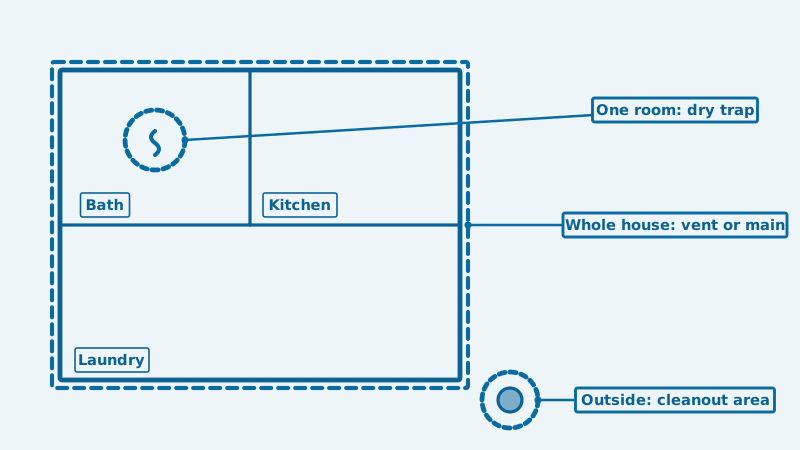
The room and the timing sort the causes. One bathroom points at that room's traps or toilet seal. A basement or garage floor drain points at a dry trap. The whole house with slow drains points at the sewer line. Outside points at a cleanout or the public sewer. Use the table to narrow it down.
| Where and when | Most likely cause | First check |
|---|---|---|
| One bathroom, mostly the sink or shower | Dry trap or hair and slime in the drain | Run water for a minute and clean the stopper |
| One bathroom, near the toilet base | Failed wax ring or loose toilet | Rock the toilet, look for staining at the floor |
| Floor drain in garage, laundry or basement | Trap dried out | Pour in water, about a quart or more |
| Kitchen sink, worst when the disposal runs | Food rotting in the drain or disposal | Clean the disposal and the trap |
| Whole house, with slow or gurgling drains | Main line partly blocked or damaged | Look for other warning signs, call for a camera look |
| Outside near a cleanout or in the yard | Loose cleanout cap or a leak in the lateral | Check the cap, look for wet ground |
| After laundry | Washer drain standpipe or trap dry or partly blocked | Check the standpipe and trap |
| After a remodel or new construction | Unsealed or unconnected drain, missing trap | Check new fixtures and any capped lines |
| Only when windows are shut and heating is on | A weak trap or vent, easier to notice indoors | Refill unused traps, then look at vents |
If you cannot place the smell, walk through the house with your nose at each drain after running water. The strongest drain is usually the culprit.
Why does the smell come back after rain or in winter?
Rain and winter do not cause the smell, but they change how noticeable it is. Closed windows keep the smell in the house. A furnace dries out nearby floor drains faster, which opens the gas path. Heavy rain can also stress the public sewer, which makes odors outside or in a drain more likely.
Two patterns to know:
- Winter. Floor drains near a furnace or water heater are among the traps that dry out most often, because the heat evaporates the water. With the house closed up, a small leak of gas is easier to notice.
- Rain. If the smell is strongest outdoors, near a manhole or on the street, it may come from the public sewer. In the City of Los Angeles, LA Sanitation takes reports of sewer problems, including odors from the public system, on its 24-hour line at 1-800-773-2489.
If the smell comes with a backup, such as water rising in the lowest drain after heavy rain, that is a separate and urgent problem. See emergency sewer backup.
Is it sewer gas, or natural gas?
If the smell is like rotten eggs and you are not sure where it comes from, treat it as a possible natural gas leak first. Leave the house, do not switch lights or appliances on or off, and call SoCalGas at 1-800-427-2200 from outside, or call 911 if life or property is at risk or you cannot reach SoCalGas. As general advice, not from SoCalGas, do not go back in until SoCalGas or the fire department says it is safe.
Natural gas has no smell of its own. Utilities add a rotten-egg odor so people notice a leak. That is why the two smells are easy to confuse. Do not take a chance:
- Leave first, investigate later.
- Call from outdoors or a neighbor's home.
- As general advice, call 911 if anyone feels ill.
- Do not rely on your nose alone. Some people cannot smell the odor well, and other smells can mask it.
If the gas company finds nothing, you are dealing with sewer gas, and the checks above apply.
What are four warning signs that your sewer line is broken?
A broken sewer line usually shows more than a smell. The four warning signs to look for are drains slow or gurgling in more than one fixture, repeat backups, wet or sunken ground along the path of the line, and a sewer smell that stays after you refill the traps. Two or more together mean it is time for a camera look.
What to watch for:
- Several drains slow or gurgling at once. One slow drain is a clog. Several are the line.
- Backups that return. A drain clears and clogs again within weeks.
- Wet or sunken ground. Soggy lawn or a dip in the soil above the line.
- A smell that does not go away. You have refilled every trap and checked the toilet seals, and the smell remains.
Older homes are more likely to have clay, cast iron or Orangeburg laterals that crack or open at joints, which allows gas to escape underground. If the City of Los Angeles is where you live, the owner is responsible for the whole private lateral, so a persistent smell with these signs is worth investigating. See sewer smell in the house for the main-line view and sewer drain smell in the house for fixtures, traps and vents.
When is a sewer smell dangerous?
Treat a strong smell as urgent if anyone has a headache, nausea, dizziness or irritated eyes, or if the smell is in a closed space such as a basement or sump pit. Get everyone into fresh air, ventilate, and seek medical advice. A faint smell near a dry drain is a nuisance, not an emergency.
At low levels, the gas is mostly unpleasant. At high levels it is dangerous, and it can dull your sense of smell so you stop noticing it. That is why a strong smell with symptoms means leave and ventilate, not stay and investigate. Do not enter a sump pit, a crawl space or an open sewer to find a source.
For anything beyond a dry trap, choose a professional to find the source rather than guessing. A local drain cleaner can inspect the line with a camera and tell you whether the smell comes from a fixture, a vent or the sewer line. For a written price once the source is found, the quote page is where to ask, and we'll arrange the visit. If the smell comes with sewage coming up, call right away and see main line drain cleaning. Gurgling often comes before a smell, so also see gurgling drains. A smell with no backup usually means a scheduled visit is enough, while sewage coming into the house calls for an emergency service. Tell the business which locations in the house smell strongest, since that saves time.
Questions people ask
Will pouring drain cleaner get rid of a sewer smell?
Usually not, and it can make things worse. If the smell comes from a dry trap, a failed seal or a damaged pipe, drain cleaner does nothing for it. Plumbers also warn against it because it can damage pipes and splash, and mixing it with other products can release dangerous gas. Find the source first.
How do I fix a sewer smell in the basement?
Start with the floor drain. Pour in a quart or more of water to refill the trap, and a little mineral oil on top slows evaporation. If the smell stays, check the cleanout cap, the sump or ejector pit lid, and any capped pipes. If it persists, there may be a damaged pipe below the slab and a camera look is the next step.
Why is drain cleaning so expensive?
Price follows the method and the access. A cable through an open cleanout is a short job, while a long line with roots, no cleanout or a camera check takes more time and equipment. Emergency calls cost more. Get a written quote and see drain cleaning cost for typical ranges.
Why does my drain keep clogging and smelling?
Hair, grease and soap build a film that holds food and sludge, and the film itself smells. Clean the stopper and trap and flush with hot water. If it returns within days, the blockage is beyond the trap, in the branch or main line, and a camera can show why.
Sources used
Page updated