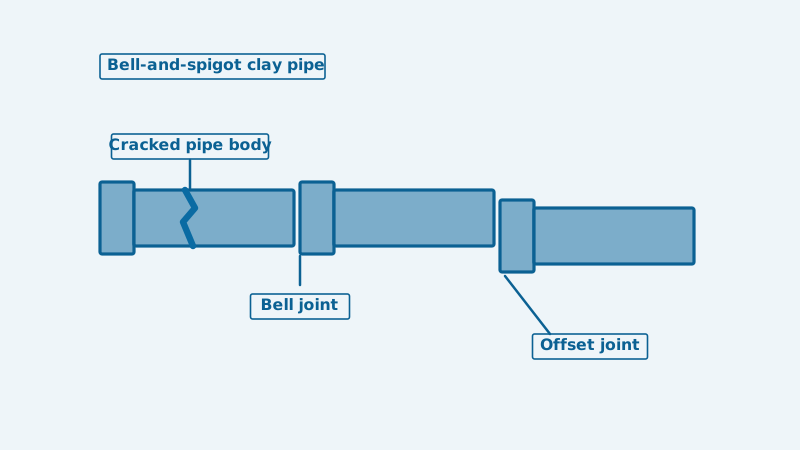
You repair clay sewer pipe in one of four ways: dig up and replace a broken length, fit a sleeve or short liner from inside, line the whole run with resin, or replace the line. A single crack or one offset joint in otherwise good pipe is a spot repair. Damage along the whole run is a lining or replacement job. Everything starts with a camera, because a repair chosen without one is a guess. Our drain cleaning service pages show what else we arrange.
How do I repair a broken clay sewer pipe?
Find the break with a camera, dig down to it, cut out the damaged length on both sides, and fit new pipe joined to the old with shielded couplings. Bed it on firm gravel, backfill in layers, and test the line before closing. This is the usual repair when one section has cracked or a joint has dropped.
It sounds simple and often is not. The pipe may sit deep, under a slab, a driveway or a root-bound tree. The hole may need shoring. And you have to know the break is the only one, because a spot repair on a tired line often fails again a few feet away.
If you want to try the cut yourself, our guide on how to cut clay sewer pipe walks through the tool, the coupling and the dust hazard. Many owners find that digging, shoring and permits make this a job for a pro.
Can I repair clay pipe without digging?
Sometimes. A short resin sleeve or spot liner can seal a single crack or a leaking joint from inside the pipe, and a full liner can seal the entire run. Cured-in-place lining pulls a resin-soaked felt tube through the old pipe and cures it into a tight, jointless new pipe within the old one.
Lining has limits, set out in published descriptions of the method. The pipe must be in place and open. Obstructions have to be removed first. The liner can wrinkle at bends. And after lining, the line cannot be cleaned with blades, only with water. A collapsed or badly offset pipe usually cannot be lined until it is repaired.
For the full explanation, see sewer pipe lining and the no dig sewer line repair hub.
Should I repair clay sewer pipe or replace it?
Repair a section when a camera shows one defect and sound pipe on either side. Replace or line the run when it shows roots at many joints, several cracks, a sag or a collapse. A repaired joint beside five failing ones is money spent on the wrong end of the problem.
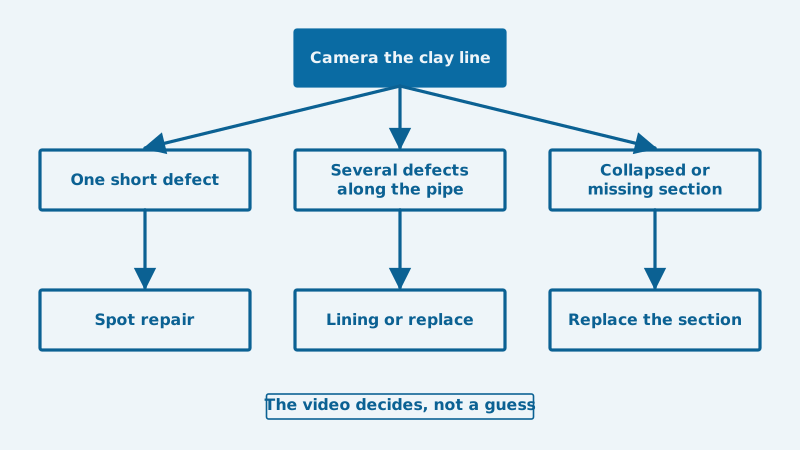
Use this table as a starting point. The costs are rough published figures and none are quotes.
| Situation on camera | Likely approach | Rough published range |
|---|---|---|
| One cracked or offset length | Dig and replace the section | $1,500 to $5,000 |
| One leaking joint | Internal sleeve or short liner | A few hundred to a few thousand dollars |
| Roots and cracks along the run | Full liner | About $5,000 to $12,000 for a typical lateral |
| Collapsed, sagging or crushed pipe | Replace by pipe bursting or open trench | About $6,000 to $13,000 for a 50 foot lateral |
The ranges come from published guides and local business prices. Hillsides, depth, concrete and long runs push the price up. Our pages on sewer line repair cost and sewer pipe lining cost per foot go into the drivers.
If you are deciding between lining and replacement, pipe lining versus replacement is the page to read.
How do I replace clay sewer pipe?
Replacement means taking out the old line and putting in new pipe, by open trench or by pipe bursting. In an open trench, the crew digs along the whole run, removes the clay, lays new plastic pipe at a steady fall and backfills. Bursting pulls an expander head through the old pipe, breaking it outward while new pipe follows.
Pipe bursting needs a launch pit and a receiving pit rather than a trench, so it disturbs less lawn and paving. It does not suit every pipe, and a line that has collapsed or has a sharp bend can defeat it. The route is chosen after the camera, not before. See trenchless pipe replacement and sewer line replacement cost.
New plastic pipe also solves the joint problem, since it comes in long lengths with fewer joints and no mortar to crumble.
What do Los Angeles rules say about repairing a clay lateral?
You, as the owner, are responsible for the whole lateral, including the part under the street, according to Los Angeles County Public Works. Repairs on private property generally need a plumbing permit. Repairs in the public right of way need a separate city permit issued to a bonded sewer contractor.
Two practical points follow:
- Who may do it. California's contractors board lists general engineering, plumbing, sanitation system and pipeline contractors as the classes allowed to install or repair building sewers. Check any contractor's license on the board's website before you sign.
- A rebate. LA Sanitation runs a sewer lateral repair rebate, up to $2,500 on its current terms, for repairs by a bonded sewer contractor. Its rules and the amount change, so read the program page before you book.
Keep the camera footage and the invoice. Both matter if you apply for the rebate or later sell the house.
When should I call someone?
Call when the break is under concrete, in the street, deeper than a few feet, or when a backup is under way. Do not try to repair a line that is full of sewage. A visit starts with a camera, then a written price for each option.
Send a quote request and we'll arrange a visit from a local drain cleaner. You get the price in writing before any work starts. If waste is already coming up in the house, our page on emergency sewer line repair explains what to do while you wait.
Questions people ask
Can you patch a cracked clay sewer pipe?
Yes. A small crack in an otherwise sound pipe can be sealed with an internal sleeve, or the cracked length can be dug out and replaced. Patches do not fix tired pipe. If a camera shows more cracks or failing joints nearby, a patch will fail again and lining or replacement is the better spend.
How much does it cost to repair clay sewer pipe?
Published figures for a single section run from about $1,500 to $5,000, with deeper or harder digs costing more. Lining a typical lateral is often quoted around $5,000 to $12,000. A written quote after a camera look is the only real price, because depth, access and length change everything.
How long does a clay sewer pipe repair take?
A spot repair is often a day, plus permit and inspection time. Lining usually takes a day for the cleaning, camera and cure. A full replacement by trench or bursting can take several days. Timing depends on the permit, the depth and whether paving must be cut and replaced.
Is it cheaper to line or replace clay pipe?
Lining is often cheaper when the pipe is still round and joined, because there is less digging and surface repair. Replacement can be cheaper on a short, shallow line in open ground, and it is the only choice when the pipe has collapsed. Get both prices after the camera.
Do I need a permit to repair a sewer pipe in Los Angeles?
Usually yes. Private-side plumbing work generally needs a city plumbing permit, and work in the street or sidewalk needs a separate permit for a bonded sewer contractor. Ask whoever does the work to pull the permits, and confirm the current rules with the city before work starts.
Sources used
- Los Angeles County Public Works, Sewer: owner responsibility for the lateral
- LA Sanitation, Sewer Lateral Repair Rebate
- CSLB, Building Official Information Guide, who may install or repair building sewers
- Cured-in-place pipe, method and limits
- Pipe bursting, overview
- Published repair prices from California plumbing businesses and cost guides, checked November 2026
Page updated