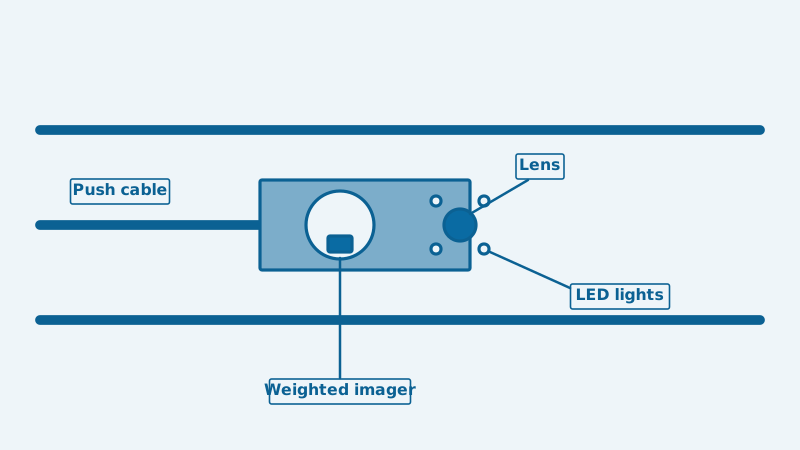
A self-leveling sewer camera is a push camera whose head stays upright as the rod twists and rolls through the pipe, so the picture does not spin. A locator is the handheld receiver that finds a small transmitter, the sonde, built into the head, so you can mark the camera's position above ground. If you want the buy or hire decision, read our main guide to the sewer camera with locator. Here we look at how the parts work.
How does a self-leveling sewer camera keep the picture upright?
It does it with weight, with a floating sensor, or with electronics. In the common design, the camera sits inside the head on a bearing with a small weight attached, so gravity keeps it right side up whatever way the head rolls. The monitor shows the floor of the pipe at the bottom of the screen.
Without leveling, a push rod that twists as it moves makes the image rotate, and you lose track of which way is up. That makes it hard to say whether a crack is on the top of the pipe or the side.
The three approaches that manufacturers and patents describe:
- Weighted body. The camera spins freely on a bearing and a weight keeps it level. It is simple and common.
- Floating sensor. Some heads use a sensor suspended in liquid that holds its orientation.
- Electronic correction. A sensor detects tilt and the picture is corrected digitally. This lets a head be smaller, but the details differ by product, and descriptions often do not say how it works.
Some cheaper units describe themselves as self-leveling with a "gravity sensor," without saying which of the three it is. Treat that as a reason to ask.
What is the difference between self-leveling and rotating camera heads?
A self-leveling head keeps the image upright by itself. A rotating or pan-and-tilt head lets the operator turn the view on purpose, which is useful for looking up a branch or around a joint. The two are different tools, and some cameras on larger crawlers have both.
Rough guide to which suits what:
| Head type | Strength | Weakness |
|---|---|---|
| Self-leveling | Picture stays the right way up on a push rod | Cannot be aimed sideways |
| Pan and tilt | You can aim at a joint or a branch | Needs a motorized head, so it is larger |
| Fixed head | Small and cheap | Picture rotates with the rod |
For a house lateral of 4 inches, a self-leveling push camera is the usual tool. Crawlers and pan-and-tilt heads are mostly used in larger pipe. The sewer pipe inspection camera page covers hiring a service that uses either.
What does the locator do?
The locator is a receiver you carry over the ground. It picks up the signal from the sonde in the camera head, which tells you where the head is and roughly how deep. The usual sonde frequency on push cameras is 512 Hz, so the receiver has to be tuned to it. Right over the head, the signal is strongest.
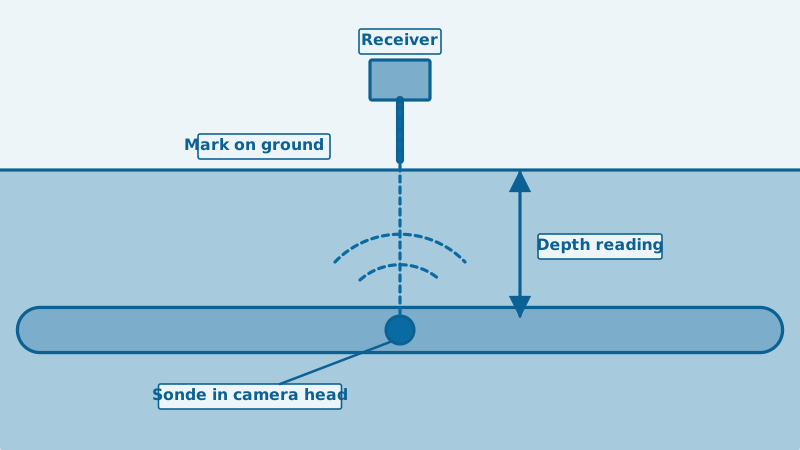
In practice, the operator pushes until the screen shows a defect, notes the footage counter, then sweeps the line above ground with the locator until the signal peaks. A paint mark or flag goes on that spot. Treat the depth figure as an estimate, because metal in the ground and reinforced slabs can throw it off, and confirm before anyone digs.
What to check on a locator:
- Whether it reads depth as well as position
- Whether the sonde's frequency matches the receiver
- Whether a battery lasts a full job
- Whether it works in your soil and around metal
A locator matters only where you must know where a defect lies. It is not needed to see the inside of the pipe.
What specifications matter on a self-leveling sewer camera?
Check the cable length and stiffness, the camera head size, the monitor size and recording method, the footage counter, the sonde, the lighting and the waterproof rating. Match the head to the pipe: a small head fits traps and tight bends, and a larger one gives better light in bigger pipe.
| Spec | What to look for | Why it matters |
|---|---|---|
| Cable length | Long enough to reach from your cleanout to the main | A short cable cannot finish the run |
| Cable stiffness | Firm enough to push, flexible enough to turn | A soft cable coils, a stiff one jams at bends |
| Head diameter | Fits your pipe and any trap | A big head will not pass a trap or a bend |
| Lighting | Bright LEDs that can be dimmed | Glare and shadow hide defects |
| Recording | Saves video to a card | A look with no record cannot be shown to anyone |
| Footage counter | Overlays the distance | You can find a defect again |
| Sonde | Built in, with a matching locator | Needed to mark a spot |
Do not pay for features you will not use. A camera built for a plumber who runs it weekly is a different purchase from one a homeowner uses twice.
How do you see tree roots with a sewer camera?
Roots show up as pale threads or brown hairy masses at joints and cracks, often with a pool of water behind them. At a joint, fine hairs entering from the side are early roots. A thick wad that fills the bore is a root ball. You can often see where they enter, which is why the camera matters.
What the camera tells you about roots:
- Where they enter. Joints are the usual place, and a cracked length is another.
- How bad they are. A fringe at one joint is minor. A mass at several is a recurring problem.
- What to do. Cutting clears them, and a root treatment can slow regrowth. Lining or repairing the joint stops entry.
A camera cannot see through a blockage of roots, so the line may need cutting first. Our guides to signs of tree roots in a sewer line and how to get rid of roots in a sewer line cover the steps.
What are the limits of a push camera?
A push camera can only go where the rod will go. It stops at a collapse, a heavy blockage or a bend it cannot turn, and it cannot reliably look into a branch. It also depends on the person reading it. A bad picture or a rushed look will miss things.
If the camera stops, note the footage reading. That number is itself a finding, because something is stopping it. A longer or smaller camera, a crawler, or cleaning the line first may get past it.
If you want a person to run and read it for you, the sewer camera inspection page explains the visit, and camera drain inspection cost the price. Los Angeles Sanitation has a rebate for camera inspections of private laterals by a bonded sewer contractor, so a DIY look does not qualify.
You can send a quote request, and we arrange for a local drain cleaner to run the camera and locate any defect, with the price in writing first. Nothing is done until you agree. The LA Drain Works home page lists what else we arrange.
Questions people ask
Does a self-leveling camera mean the picture is always upright?
Mostly. A weighted head stays upright in a round pipe, but it can tilt in a pipe with a flat bottom or a lot of debris. A head that is too small for the pipe can also roll. If the picture is not level, check that the head is clear of debris and sized to the pipe.
What frequency does a sewer camera sonde use?
Many push camera sondes transmit at 512 Hz, and locators are made to receive it. Some locators also read other frequencies for tracing pipes and cables. Check that the receiver and the sonde match before you buy or rent, since a mismatch means the locator will not find the head.
Can a camera with a locator find a pipe under concrete?
A locator can detect a sonde through soil and concrete, but rebar and thick slabs weaken or distort the signal. Depth readings in that situation are less reliable. A plumber with experience will check the reading from more than one side before marking a cut.
How long a cable do I need for a house sewer line?
It depends on the distance from your cleanout to the city main. Many laterals are less than a hundred feet, but some are longer, especially on deep lots. Measure the distance or ask a plumber, and choose a cable longer than the run, since a short one cannot finish the job.
Is a self-leveling camera better than a standard one?
For reading defects on a house lateral, yes, because you always know where up is. A fixed head costs less but rotates with the rod, which makes the picture harder to read. For larger pipes and long runs, a crawler or a pan and tilt head is the better tool.
Sources used
- Pipeline video inspection, camera types
- Patent descriptions of self-leveling camera heads, including US 6,611,661 and US 9,277,105
- Manufacturer descriptions of self-leveling push cameras with 512 Hz sondes, read November 2026
- LA Sanitation, Sewer Lateral CCTV Rebate
Page updated